

Speed Limits in Dubai (and the Camera Buffer)
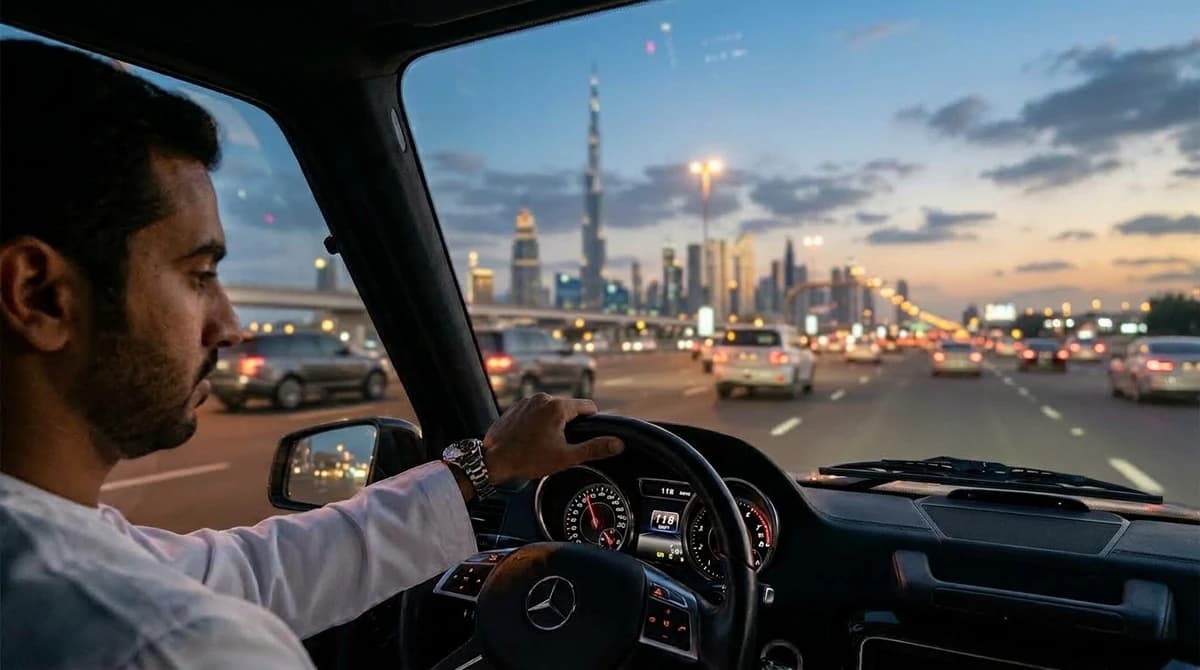
Dubai's radars still give you a margin. On a road posted at 100 km/h the camera is set to trip at 121, and on a 120 stretch it trips at 141. That comes from the Dubai Police list of road and radar speeds, which Gulf News republished with an update in June 2026. Abu Dhabi scrapped its margin on 12 August 2018, so the moment you cross the border 81 on an 80 road is a fine. Sheikh Zayed Road is 100 through the city and 120 on the run out past Jebel Ali. The road-by-road table below covers the rest of the speed limits in Dubai, then the buffer in detail, the gantry signs, the fine bands and the cameras that issue them.
Every main road and its posted limit
The posted figure is the law. The radar figure is where the camera starts recording, and it matters only on Dubai's side of the border. Two roads change limit along their length, so check which section you're on.
| Road | Posted (km/h) | Radar trips at (km/h) | Worth knowing |
|---|---|---|---|
| Sheikh Zayed Road (E11), city section | 100 | 121 | From the Trade Centre end through Downtown, Business Bay and the Marina stretch |
| Sheikh Zayed Road (E11), outer section | 120 | 141 | The run past Jebel Ali to the Abu Dhabi border, signed overhead |
| E11 inside Abu Dhabi emirate | 140 | 141 | Cut from 160 on 14 April 2025. No margin on this side |
| Al Khail Road (E44) | 100 | 121 | Same limit end to end |
| Emirates Road (E611) | 110 | 131 | Cut from 120 on 15 October 2017 and still 110 |
| Sheikh Mohammed bin Zayed Road (E311) | 110 | 131 | Same 2017 cut. Not 120, despite what older guides say |
| Dubai to Al Ain Road (E66), Bu Kadra to the Emirates Road interchange | 100 | 121 | Reduced in September 2018 because of truck traffic |
| Dubai to Al Ain Road (E66), beyond Emirates Road | 120 | 141 | Abu Dhabi rules once you cross into that emirate near Al Faqa |
| Dubai to Hatta (E44), Al Aweer Road | 100 | 121 | The city end of the Hatta run |
| Dubai to Hatta (E44), Hatta Main Road | 80 to 100 | 101 to 121 | The middle stretch crosses Sharjah and Oman, so follow the signs there |
| Jumeirah Beach Road (Al Jumeira Road) | 70 | 91 | 70 the whole way, and it feels slower than it is |
| Al Wasl Road | 70 | 91 | |
| Hessa Street | 80 to 100 | 101 to 121 | Two sections, and the sign changes between them |
| Umm Suqeim Street | 90 | 111 | Raised from 80 in September 2018 between E311 and Al Sufouh |
| Airport Road and the Airport Tunnel | 80 | 101 | The tunnel camera catches a lot of first-night drivers |
| Sheikh Rashid Road (airport approach) | 100 | 121 | Airport Road itself is 80, so ease off at the split |
| Residential streets | 40 | Follow the sign | Not on the Police list. Some villa communities post 25 or 30 |
Two roads deserve a second look. The E311 and E611 feel like 120 roads, and they were until 2017. Both radars sit at 131, and a driver holding 135 on Emirates Road because it looks empty is the single most common fine we see on a weekly rental. The other is the E66. It's 100 for the first stretch out of the city and 120 only after Emirates Road, and the 100 section is exactly where the trucks and the cameras are.
What the camera actually flashes at
The margin is real and it's official. Dubai Police publishes two figures for every major road, the posted limit and the radar control limit, and on almost every road the gap is 21 km/h. So 121 on a 120 road does nothing in Dubai today. Neither does 139. At 141 the camera records you at 21 over. That lands in the second fine band rather than the first, because the fine is measured against the posted limit and not the radar setting.
That's the piece most people miss. The buffer moves the trigger point, not the maths. Get flashed at 145 on the outer E11 and the violation is 25 km/h over, AED 600. You were only 4 km/h past the point where the radar wakes up.
A few honest caveats. The list covers arterial roads, and the cameras on community streets and outside schools aren't on it, so don't assume 40 means 61 there. Mobile radars are set the same way, but a patrol officer can pull you over for anything above the sign. And nothing about this margin is guaranteed. The Ministry of Interior confirmed in 2021 that the buffer stays in every emirate except Abu Dhabi, and the 2026 list still shows it. Limits and radar settings do get changed with a few days' notice, though, as Ras Al Khaimah did on one road in January 2025.
Cross into Abu Dhabi and the arithmetic changes. Abu Dhabi Police removed the 20 km/h grace on 12 August 2018 and raised most posted limits at the same time. That's why the E11 sat at 160 for years. It came down to 140 on 14 April 2025. The radar there trips at 141, so 121 on a 120 road, or 141 on that 140 road, is a fine. If you're doing the Dubai to Abu Dhabi drive, the habit that saves money is simple. Set the cruise control at the number on the sign once you pass the Ghantoot turn-off, and leave it there.
When the overhead gantry shows a lower number
The E11 and E311 carry electronic gantries that can show a limit lower than the road's usual figure. Dubai Police and the RTA drop them in fog, usually to 80, and sometimes in heavy rain or for a crash ahead. The number on the gantry is the limit for as long as it's lit. A radar under a gantry showing 80 works from 80, so 105 on a road you know as 120 becomes a fine, and the fog photo settles any argument.
Winter mornings from December to February are when this bites. Fog sits on the E311 and E611 corridors around Al Qusais and the Academic City stretch until nine or ten, and the signs change before the visibility does. Abu Dhabi went further in October 2025 and switched on a formal variable-limit system on Sheikh Zayed bin Sultan Road in the capital. There the signs move with congestion and events as well as weather. Dubai hasn't announced the same, but the fog reductions have been enforced for years.
Minimum speeds and the left lane
Dubai doesn't post lane-by-lane minimums on its highways. The one place that did was the Abu Dhabi stretch of the E311. It ran a 120 km/h minimum in the two left lanes from April 2023 and scrapped it on 14 April 2025. Its AED 400 fine went with it.
What remains is the general rule. Driving below a posted minimum, or crawling on a highway without a reason such as fog or a queue, is a separate offence at AED 400. On the E11 in practice the lane discipline camera is a bigger risk than the minimum. Sit at 100 in the left lane of the 120 section and the fine, if one comes, will be for obstructing traffic rather than for speed.
What speeding costs
The bands are federal and measured against the posted limit. Up to 20 km/h over is AED 300. Between 20 and 30 over is AED 600. Between 30 and 40 is AED 700, and 40 to 50 is AED 1,000. From 50 to 60 over the fine is AED 1,500 with 6 black points and the car impounded for 15 days. Over 60 is AED 2,000, 12 points and 30 days. Over 80 is AED 3,000, 23 points and 60 days, and 24 points in a year is a suspension. Every other category, from red lights to parking, sits in the full traffic fines list.
On a rental the fine lands on the company's traffic file first and then on you. We pass it on at the amount Dubai Police issued, with nothing added. The chain from camera to card is set out in our guide to a fine on a rental car.
The cameras you'll meet
Four kinds, and they don't all behave the same way.
Fixed radars are the grey boxes on poles and the units built into the gantries. Most photograph from behind, so the plate is in the frame whatever you do at the last second. Mobile radars sit in marked patrol cars, unmarked SUVs and on tripods on the hard shoulder, and they move around. Both work from the same control limits in the table.
The smart cameras are the newer problem. Dubai Police brought in AI units in March 2025 that read speed but also photograph a phone in your hand. That's AED 800 and 4 black points. They measure the gap to the car in front too. Tailgating is AED 400 and 4 points, and the camera doesn't care that the car ahead braked. They went onto the main highways first, and the 2026 plan pushes them onto smaller roads and commercial areas.
Average-speed sections are the one type we can't give you a map for. Dubai Police said in 2017 it was testing radars that time a car between two points on the Hatta road. It hasn't published where they run, and the rental-blog lists that claim them on the E611 aren't sourced. Treat any long stretch with a camera at each end as if the whole thing is measured, because on the Abu Dhabi side it may be.
If you're new to all this, the rest of the rules, from Salik to parking, are in our guide to driving here as a visitor. The Dubai Police radar speed list carries all 62 roads if yours isn't in the table above. And whichever car you pick from our booking page, use the cruise control if it has one. It's the cheapest speed-camera defence there is.
FAQ — Common Questions Answered.
What is the speed limit on Sheikh Zayed Road?
It's 100 km/h through the city and 120 km/h on the outer stretch past Jebel Ali towards Abu Dhabi. The change is signed overhead, and the gantries can lower either figure in fog. Dubai's radars on the 100 section trip at 121 and on the 120 section at 141. Once you cross into Abu Dhabi emirate the same road is posted at 140 with no margin at all, so 141 there is a fine.
Is there still a 20 km/h buffer in Dubai?
Yes, on Dubai's main roads, and it's official rather than a rumour. Dubai Police publishes a radar control limit for each road that sits 21 km/h above the posted limit, and the list was still current in June 2026. The fine is still calculated from the posted limit, so a flash at 141 on a 120 road is a 21 km/h violation and costs AED 600, not AED 300. Abu Dhabi has had no buffer since August 2018, and community streets and school zones in Dubai aren't on the list, so don't rely on it there.