

Rental Car Insurance in Dubai Explained: CDW, Excess and Full Cover
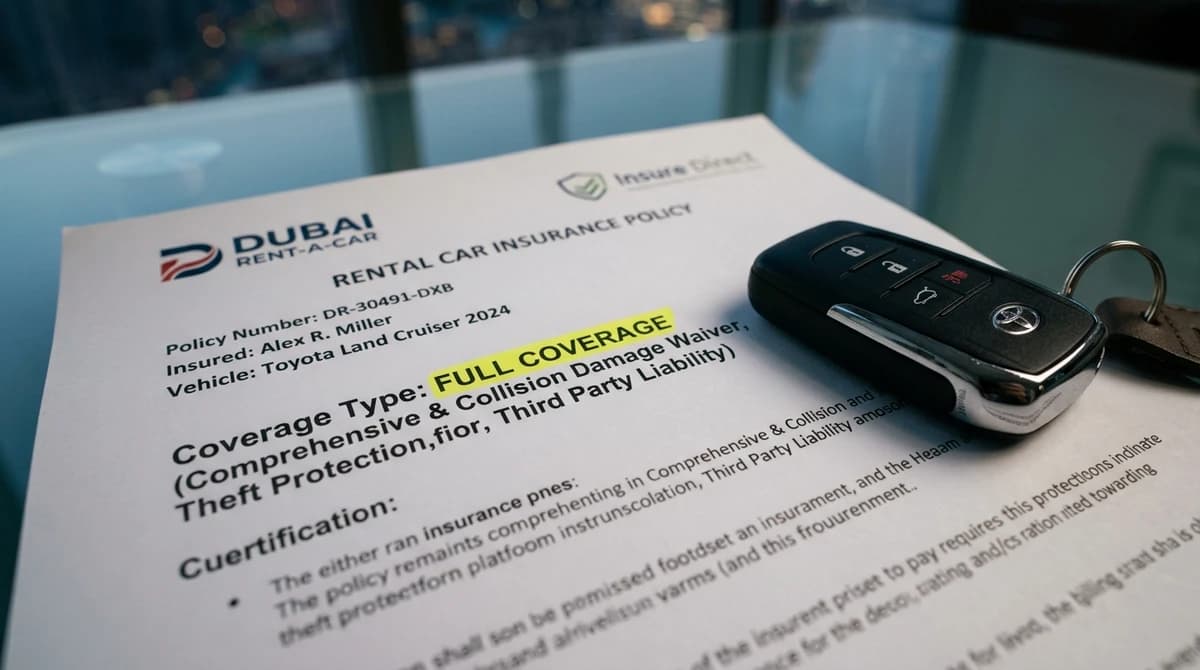
Every rental car in Dubai already carries insurance, so the extra you're offered at checkout doesn't buy you cover. It buys you a smaller excess. Once that's clear, rental car insurance in Dubai, explained properly, comes down to a short glossary and a sum. The glossary is first. Then the sum: an AED 1,500 excess set against a waiver at about AED 25 a day, over a week and over a month. You can see for yourself when the waiver is worth the money. The last part is the one the rental desks skip, because it's where we tell some people not to buy it.
The terms, in plain words
Eight terms turn up on every quote page and rental agreement. None of them is hard once you've seen what it does to your bill.
Third-party cover and full cover
Third-party cover pays for the other car and the other people when you're at fault. UAE law makes it compulsory on every registered vehicle, rental cars included. Full cover, which the policy documents call comprehensive, adds the car you're driving: collision, fire, theft, vandalism. The insurance included with our cars is the full kind, covering the vehicle and third-party liability, so the rest of this post treats third-party as a given.
Excess, or deductible
The excess is the first slice of an at-fault repair bill that the insurance leaves with you. If the excess is AED 1,500 and the repair comes to AED 9,000, you pay AED 1,500 and the insurer pays the rest. It's a cap on your exposure, not a fee you pay up front, and it's a different thing from the security deposit. The deposit is a hold that comes back. The excess is only ever charged when something has gone wrong.
Processing fee
An administrative charge added to a damage claim on top of the excess, for the paperwork and the insurer's claim handling. It's on the agreement, so read it before you sign rather than after a scrape. With us, your exposure in an at-fault accident is the excess plus that fee, and the excess figure is shown per car.
CDW, or collision damage waiver
A waiver is the company agreeing not to charge you something it otherwise could. In Dubai the term is used two ways. Some companies call the basic arrangement CDW, meaning your liability is already limited to the excess. Others sell CDW as an add-on that reduces the excess further, and that's how we use it. When you see CDW on a quote, ask which of the two it means and what the excess becomes.
SCDW, or Super CDW
The add-on that takes the excess to zero, or close to it. Also sold as full protection, zero excess, premium cover or full insurance. This is what the arithmetic below is about.
PAI, or personal accident insurance
Medical costs and a death benefit for you and your passengers. It's separate from the car's insurance, which covers the car and third parties only. If you carry travel insurance with medical cover, or you're a resident with a health card, you already have most of what PAI sells.
Off-road exclusion
Every UAE motor policy stops at the edge of the tarmac unless a rider says otherwise. Sand, wadi beds and graded tracks are off-road. Damage there sits with you in full, waiver or not, and on most rental agreements it's also a breach of contract.
Oman extension
The included insurance is valid in all seven emirates and nowhere else. Crossing into Oman needs written approval from the rental company and an Oman insurance extension arranged before you leave, or you're driving uninsured the moment you clear the border.
The sum: AED 1,500 against AED 25 a day
Market figures first. On an economy or mid-size car in Dubai the excess sits around AED 1,500. It rises to AED 5,000 on luxury and sports cars and a long way past that on supercars. A zero-excess waiver on an economy car runs roughly AED 25 to 80 a day at local companies. The international desks at the airport charge more like AED 90 to 150 a day. Those are market ranges. The exact figure for any car is on its page.
Take the low end. An AED 1,500 excess, and a waiver at AED 25 a day.
- One week: AED 175 for the waiver, against AED 1,500 of exposure. You're paying about 12% of the excess to make it go away.
- One month: AED 750, half the excess.
- Three months: AED 2,250, which is more than the excess itself.
Now the same sums at AED 50 a day, which is nearer what most local companies charge. A week is AED 350. A month is AED 1,500, the whole excess, paid in advance, whether or not you touch anything.
So the waiver is cheap insurance on a short rental and expensive insurance on a long one. Over a week it's a small premium against a bill you'd feel. Over a month it's a coin toss. Past six weeks you're better off keeping the excess and driving carefully. You've already handed over the amount you were insuring against, and the waiver still has its own exclusions.
One more thing the sum hides. Most damage on a rental car is a bumper scuff in a mall car park or a kerbed alloy, and those repairs often come in under the excess. In that case you pay the repair, not the excess, and the waiver would have covered it. That's the strongest argument for the waiver on a short trip, and how the bill is built is covered under damage charges.
Who should buy full cover, and who shouldn't
Take the waiver if this is your first time driving in Dubai and you're here for a week or less. Deira roundabouts, the merge onto Sheikh Zayed Road at 120, taxis that change lanes without looking. A scrape in the first three days is the most common damage claim there is. Take it on any car with an excess above AED 3,000, because at that level the daily price is still small next to the exposure. And take it if an unexpected AED 1,500 charge on top of the deposit hold would wreck the trip.
Skip it on a monthly rental paid with a credit card that has room on it. Monthly renters here are mostly residents driving the same route to work, and the saving over a year of monthlies runs into the thousands. Skip it if your travel insurance already reimburses rental excess, which is covered below. And skip it if what you're hoping for is cover for everything, because that isn't what it is.
Our position. Under ten days, take it unless you drive here regularly. A month or longer, keep the excess unless the car's excess is above AED 3,000.
What no waiver covers
This is where "full cover" earns its quotation marks. The waiver removes the excess for an insured accident. It doesn't widen what counts as an insured accident. The Central Bank's unified motor policy wording, the template every UAE insurer issues from, sets the exclusions, and rental agreements add a few of their own.
No police report, no claim. Every accident needs one, however small, and the steps after an accident start with the call to 901 or the Dubai Police app. Without the report the insurer treats the damage as unreported, and the full repair lands on you, waiver or not.
Drink or drug driving. For rental cars the policy makes the insurer pay the rental company and then recover the whole amount from the driver. The waiver is irrelevant at that point.
A driver who isn't on the agreement. Only named drivers are covered. Your partner taking a turn on the way back from Abu Dhabi is uninsured for that stretch, and so is the car.
Off-road use, racing and negligence. The policy wording treats each as a breach, and so do we.
Tyres, glass, the undercarriage, the interior and lost keys. Many companies leave these outside the waiver and sell them as separate products. Read the exclusions list on the waiver itself before assuming it's included.
With us, the included insurance holds across every emirate. Any of the breaches above (an unregistered driver, off-road use, racing, driving under the influence, negligence) means no cover at all. At that point the bill is the repair, not the excess.
Does your travel insurance or credit card already cover it?
Sometimes, and it's worth twenty minutes to find out. Neither works the way the waiver does, though.
Travel insurance is the better bet. A fair number of policies, UAE-issued ones included, carry rental excess reimbursement, often up to around AED 10,000, either as standard or as a paid add-on. It's a reimbursement, not a waiver. The rental company charges the excess to your card, you send the paperwork to your insurer, and the money comes back weeks later. The deposit is still held in the meantime. If your policy has it, that's the cheapest route to zero excess on any rental length, and you can decline the desk waiver with a clear conscience.
Credit cards are murkier. Cards issued in the US, the UK and elsewhere often carry rental collision cover, but there are three catches in Dubai. The benefit usually requires you to decline the rental company's own damage cover. Here the basic cover is built into the rate and can't be declined, so the issuer has to confirm it will still reimburse the excess. High-value and exotic cars are excluded on almost every card, which rules out a good share of what people fly to Dubai to drive. And cards issued by UAE banks rarely carry rental cover at all. The safe assumption is that your card does nothing until the issuer says otherwise in writing. Your home car insurance, for what it's worth, does nothing here either.
If you want to run the sum for a specific car, each car's listing on our site shows its excess figure before you pay. The CDW option to reduce or remove it sits alongside. The excess and the waiver are two lines in the total, and the cost of renting covers the rest.
FAQ — Common Questions Answered.
What is CDW in car rental?
CDW stands for collision damage waiver, and it's the rental company agreeing to cap or drop what it can charge you for damage to the car. In Dubai the term covers two things, so check which one your quote means. Some companies use it for the basic arrangement, where your liability is already limited to the excess. Others, including us, offer it as an add-on that reduces or removes that excess for a daily price. Either way it only applies to accidents the insurance would have covered anyway, and it never replaces the police report.
What does insurance excess mean on a rental car?
The excess is the fixed amount you pay towards an at-fault repair before the insurance covers the rest. On an economy car in Dubai it's typically around AED 1,500, and on luxury and sports cars AED 5,000 or more. You only pay it if the car is damaged, so it isn't a charge at booking, and it's not the same as the deposit hold. If the repair costs less than the excess, you pay the repair instead. A processing fee is usually added on top, and the amount is on your agreement.
Should I buy full cover on a rental car in Dubai?
Buy it for a short rental, especially if it's your first time driving here or the car carries an excess above AED 3,000. At AED 25 to 50 a day, a week of cover costs AED 175 to 350 against an exposure of AED 1,500 or more, which is a fair trade. Skip it on a monthly rental, where the same daily price adds up to most or all of the excess whether you need it or not. And skip it if your travel insurance already reimburses rental excess.
Does travel insurance cover rental car excess in the UAE?
Some policies do, including many issued by UAE insurers, and the limit is often somewhere near AED 10,000. It works by reimbursement, so you pay the excess to the rental company first and claim it back with the agreement, the police report and the damage invoice. Check the policy wording for "rental vehicle excess" or "hire car excess" before you travel, and confirm the UAE isn't excluded. If it's there, you can decline the rental company's waiver and still end up at zero.
Is insurance included when you rent a car in Dubai?
Yes, on any car from a licensed company, because the law requires every registered vehicle to be insured and the rental company insures its own fleet. The included policy covers the car and third parties in all seven emirates. What you're responsible for is the excess plus a processing fee in an at-fault accident. If you breach the rules by drink driving, going off-road, racing or letting an unnamed driver take the wheel, you're responsible for the whole repair. Oman is not covered without a written approval and an extension arranged in advance.