

Dubai to Al Ain by Car: Route and Jebel Hafeet Drive
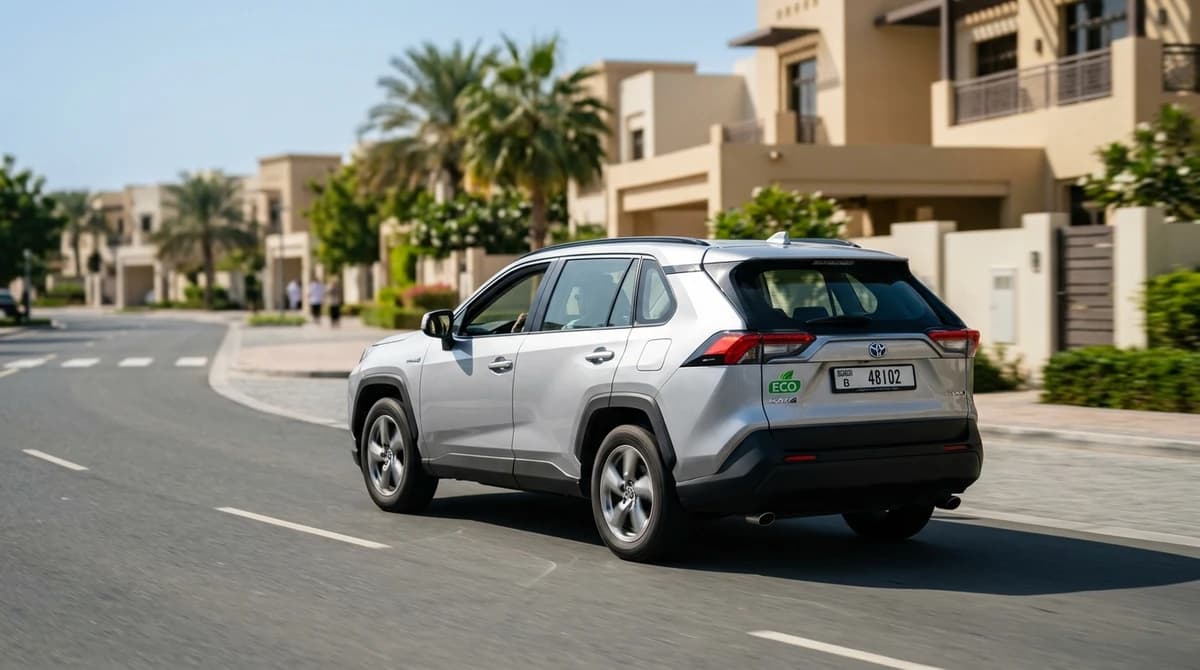
Al Ain is the day trip for anyone who wants the old UAE rather than the coast, and the Dubai to Al Ain drive is about 100 minutes from Downtown. The palm groves, the forts and the camel market are all reachable by bus. The mountain isn't. Jebel Hafeet's road climbs 11.7 km of hairpins to a free car park 1,200 m above the town, and no bus goes up it. That's the reason to bring a car. It's also why the day runs to about 320 km, which matters on a rental with a kilometre allowance. Below is the trip in driving order, with the border turn to avoid and the sums at the end.
The road out of Dubai
From Downtown or Business Bay, Al Khail Road takes you east to the Nad Al Sheba interchange, and the E66 runs from there to Al Ain in a straight line. Call it 140 km to the town centre and 165 km to the top of the mountain. Outside the morning rush that's 90 minutes to the town and two hours to the summit.
Salik depends on where you start. From Downtown via Al Khail Road you touch no gate. From Marina up Sheikh Zayed Road you pay Al Barsha and Al Safa, and from Deira you pay to cross the Creek unless you use the Infinity Bridge. There's nothing on the E66 itself, and the full gate list is in the Salik on a rental car post.
The speed rule changes at Al Faqa, the emirate line. The Dubai stretch is posted at 120 km/h and the cameras trip at 141. In Abu Dhabi emirate the signs rise to 140 on the open sections. Abu Dhabi cameras have no buffer, though, so 141 there is a fine on your rental. Fill up at any ADNOC on the way in, since the mountain road has no station.
The stops in town, in the order that works
Al Ain is spread out. The order below goes to the market first, back into the centre, then out to the mountain on the far side of town. It keeps the driving inside Al Ain under 40 km.
The camel market before nine
The market sits about 15 km south of the centre on Zayed Bin Sultan Street, the road locals call Mezyad Road, in the lot behind Bawadi Mall. It opens at six or seven and runs until seven at night, but the trading is over by mid-morning, and after that it's pens and a few bored animals. Entry is free and so is the open ground outside where everyone parks. A trader or two will attach themselves to you as a guide and expect a tip at the end, and a polite no works. Leaving Dubai by 6:30 gets you here while it's still trading.
Al Ain Oasis and the falaj walk
Back in the centre, the oasis is 1,200 hectares of date palms fed by falaj channels, and it's the stop to give the most time. The shaded paths run for a couple of kilometres, and the channels carry water through the cooler months. It's free and open from 9am to 7pm. The Oasis Hub opened at the edge of it in January 2026, with a canopy walk above the palms and sixteen places to eat. Park at the main entrance beside the Sheikh Zayed Palace Museum.
Central Al Ain runs on Mawaqif, the Abu Dhabi emirate system, so the Parkin app you used in Dubai does nothing here. The turquoise and black bays are AED 2 an hour from 8am to midnight, paid at the machine or by SMS to 3009. Outside the paid sectors, most of the museum and fort car parks are free.
Al Jahili Fort and Qasr Al Muwaiji
Both are five minutes from the oasis and both are free. Al Jahili has the Wilfred Thesiger photographs from his desert crossings in the north wing, the best hour in Al Ain for anyone who has read Arabian Sands. Qasr Al Muwaiji is the mudbrick fort where Sheikh Khalifa was born, with a glass exhibition hall in the courtyard on the Abu Dhabi rulers. Both list 9am to 7pm daily, though older listings show a Monday closure, so check the day before if Monday is your only option. Each has a free car park at the gate.
Al Ain Zoo, if you're bringing children
The zoo is on the way to the mountain, at its northern foot, with free parking by the main entrance. It reopened on 5 September after the summer closure. Until 4 October it runs afternoon hours, 2pm to 10pm, for the after-dark season, and the usual day is 9am to 6pm. Entry is AED 30 for adults and AED 10 for children on the basic ticket. It's a two-hour stop at the least, so with young children it replaces the forts rather than adding to them.
The Jebel Hafeet road
The mountain road starts on the western side of Jebel Hafeet, the opposite side from the camel market. From the zoo, Jebel Hafeet Street runs south along the foot of the mountain to Green Mubazzarah, the park of hot springs and lawns at the base. Parking there is free, on a winter Friday it's full of families with barbecues, and signs inside the park point to the start of the climb.
The road is 11.7 km with three lanes, two climbing and one coming down, and 21 corners by The National's count, tightest at the bottom. It's paved to the top car park, which is free, so a Nissan Sunny does it as easily as a Tahoe. There's no off-road element and nothing a rental agreement objects to. The main viewpoint car park, a little over halfway up, looks down on Al Ain with the Omani side of the mountain behind you. The Mercure Grand is at the top, and its terrace is the reason to time the climb for the last hour of light. In December the sun is gone by 5:45, so leave the town by 4:30. On weekend evenings the summit car park fills, and the pull-offs on the way down are the better stop anyway.
Take it slowly coming down. The brakes on a small car get hot over 11 km of descent, so use second gear on the lever or the paddles rather than the pedal. The official Jebel Hafit visitor page covers the Bronze Age tombs and the desert park below if you have time for either.
The turn that leads to Oman
Jebel Hafeet sits on the border. The summit and the whole of the mountain road are inside the UAE, but the eastern flank is Oman. Zayed Bin Sultan Street, the camel market road, carries on south down that side for another 10 km or so. It ends at the Mezyad border post, the crossing into Oman for Ibri and Nizwa.
So the mistake is leaving the camel market and following the same road south because the mountain is in view. That road never reaches the mountain road. It reaches the border signs and then the checkpoint plaza, and if that happens, turn round before the barriers. Put "Green Mubazzarah" or the Mercure into the map rather than "Jebel Hafeet". The mountain straddles the line, and a pin on the wrong side of it can route you round through Oman. The other trap is arriving from the east. A map route from Hatta or Fujairah to Al Ain runs through the Omani town of Mahdah, and a rental can't take it.
The reason is insurance. The included insurance on our cars is valid across all seven emirates and stops at the border post. Taking the car into Oman needs written approval from us and an Oman insurance extension arranged before you leave, and neither can be sorted at the checkpoint. The rental car to Oman post covers how that's arranged. For a day in Al Ain the answer is that you don't cross.
Which car to take
Any car on the fleet does this trip. The E66 is flat, the town is flat, and the mountain road is tarmac at an 8% average gradient. A Sunny at AED 75 a day climbs it without complaint. What changes with the car is comfort over 320 km. A Geely Coolray or a JAC JS4, at AED 109 to 132 a day, gives you a higher seat and stronger air conditioning.
The one rule that applies near the mountain is off-road. Jebel Hafit Desert Park has graded tracks to the tombs and the campsites, and driving them in a rental is a breach of the agreement, whatever the car. The insurance stops where the tarmac does, and the recovery bill for a car stuck in a wadi is yours.
When to go, and the kilometre sums
October to April. Al Ain is inland and dry, so winter mornings are cooler than Dubai, and the summit is cooler again. In July the town runs hotter than the coast at midday, and the oasis and the market are both on foot, which is why we tell people to save Al Ain for the cooler months. If you're stuck with a summer date, do the zoo in its evening hours and the mountain after dark, when the lit road is the whole point.
Then the allowance. Downtown to the summit and back is about 330 km, and the town alone is 300, before the 40 km between stops. That's over a 250 km day and over a 300 km one too. On a one-day rental the overage is charged per km at the rate on your agreement, and on a Sunny it's a few dirhams. On a weekly booking the allowance is one pool for the week, 2,100 km on almost every car, so an Al Ain day fits with room around it. The itineraries that fit and the ones that don't are in the mileage allowance post. Al Ain's place among the other road trips from Dubai is in the pillar guide. Every car on our site lists its allowance beside the daily rate.
FAQ — Common Questions Answered.
How long is the drive from Dubai to Al Ain?
About an hour and forty minutes from Downtown to the town centre outside the rush, and two hours to the top of Jebel Hafeet. It's 140 km on the E66 with no Salik gate on the road itself, and the limit rises from 120 to 140 once you cross into Abu Dhabi emirate. Leave Dubai by 6:30 and you're at the camel market while it's still trading. Plan on a 12-hour day if you want the mountain at sunset.
Is Jebel Hafeet worth the drive?
Yes, and it's the part of the day that needs the car. The road is 11.7 km of paved hairpins with viewpoints on the way up, free parking at the top and a hotel terrace for the sunset. It's not off-road, and any rental can do it. With only half a day in Al Ain, do the oasis in the morning and the mountain in the late afternoon, and leave the forts for another visit.