

Mileage Limits and Fuel Policy on Dubai Rental Cars
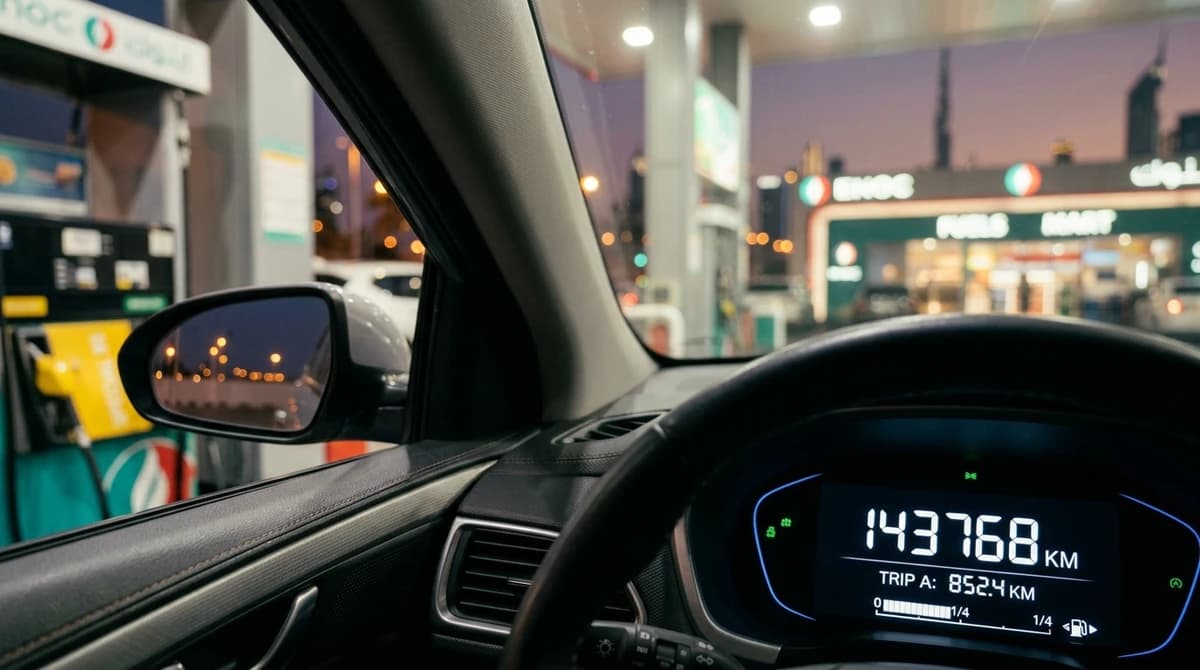
There's no unlimited mileage in Dubai, whatever the banner on a booking site says. The mileage limit on a rental car in Dubai is set per plan. A week buys you about 2,100 km on most of our cars, and every kilometre past that is billed at the per-km rate on your agreement. The trip that quietly eats that allowance is Jebel Jais. From Downtown it's about 400 km there and back, a day and a half of allowance spent on one drive. Most people do it in the same week as Abu Dhabi and Hatta.
So the question a road-tripper needs answered is which week fits inside the cap and which one doesn't. Below is the arithmetic for the common itineraries and what the overage costs when you do go through. After that comes the other contract term that catches people at the return: the fuel rule.
How many kilometres a rental includes
The allowance is printed on the car's listing, and it's the first number to read after the daily rate. Across the Dubai market a day on an economy or mid-size car includes 200 to 300 km. Sports and luxury cars are tighter, usually 150 to 250 km, because those are the cars where a kilometre costs the company real money in wear.
With us there's no unlimited plan on any car. A Nissan Sunny shows 250 km a day, and almost every other car shows 300. Seven days at 300 makes a 2,100 km week, while the Sunny's week comes to 1,750. The allowance scales with the booking length, so a month carries a lot more than a week.
The detail that matters for a road trip is that the weekly figure is a total for the booking rather than a daily ration. The odometer reading at handover is compared with the reading at return, and the difference is set against the whole allowance. So a 400 km day is fine if three other days are quiet, and that's exactly what the sums below rely on.
Does a week of road trips fit inside a 2,100 km week?
Here's the part the other guides skip. The distances below are round trips from Downtown Dubai, to the nearest ten or so kilometres. Start from Marina or JBR and add 30 km to anything heading south, or from Deira and add 20 km to anything heading north. The road trips from Dubai guide has the routes themselves.
| Trip, from Downtown Dubai | Round trip | Share of a 2,100 km week |
|---|---|---|
| Abu Dhabi (Corniche, Louvre, Yas) | about 280 km | 13% |
| Hatta (dam, town, Wadi Hub) | about 260 km | 12% |
| Fujairah, out and back | about 250 to 300 km | 12 to 14% |
| East-coast loop (Fujairah, Khor Fakkan, Dibba, back via RAK) | about 360 km | 17% |
| Al Ain, with the Jebel Hafeet climb | about 300 to 330 km | 14 to 16% |
| Jebel Jais summit | about 380 to 400 km | 18 to 19% |
| A normal day inside Dubai (hotel, mall, beach, dinner) | 40 to 60 km | 2 to 3% |
A week that fits
Three city days, Abu Dhabi, Hatta, Fujairah out and back, and Al Ain. That's about 150 km of city driving plus roughly 1,120 km on the road, call it 1,270 km. You've got 830 km spare, which covers every detour you'll make and a late-night airport run. This is the week most first-time visitors drive, and the cap never enters the conversation.
A week that doesn't
Abu Dhabi, Hatta, the east-coast loop, Jebel Jais, Al Ain, and two city days. On paper that's about 1,720 km, which looks comfortable against 2,100. On a Nissan Sunny, whose week is 1,750 km, it already doesn't fit. Abu Dhabi from the Louvre to Yas Marina to a Corniche dinner adds 60 km inside the city. Hatta done properly, with the Hatta road trip detours to the dam and back to the town for lunch, adds 20 km. Driving the Jebel Jais summit road twice for sunset adds 40 km. A week like this lands 100 to 200 km above the paper figure, every time, so call it 1,900 km. On a 300 km a day car that still fits. On the Sunny you are over the line before Hatta.
The fix is cheap if you do it at checkout. Because the allowance scales with the booking, an eighth day adds allowance as well as time. On an economy car the day rate is about what 100 km of overage would cost anyway. Or drop one trip. The east-coast loop and the Fujairah out-and-back cover much of the same coastline, and nobody needs both in one week.
What extra kilometres cost, and how they're counted
The per-km rate sits on the rental agreement, and it's the second number to read. Bintali charges extra kilometres per km at the rate on the agreement, calculated from the odometer readings at handover and return. Photograph both readings yourself, in the same frame as the dashboard clock if you can, so there's no argument later about which figure was written down.
For the market as a whole, the rate runs by car class. Economy cars sit at about AED 0.50 to 1.00 per extra kilometre. Mid-size sedans and compact SUVs are around AED 1.00 to 1.50, and larger SUVs AED 1.50 to 2.50. Luxury and sports cars start near AED 3.00 to 5.00 and go far past that on supercars. Those are market ranges, and the figure that binds you is the one on your own agreement.
Put that against the week that doesn't fit. Going 150 km over on a Sunny costs somewhere between AED 75 and 150. The same 150 km on a Tahoe is AED 225 to 375, and on a Mustang or a Camaro it's AED 450 to 750. On the economy end the cap is a rounding error against the week's rental. On the sports end it's the price of another day, which is why the arithmetic above is worth five minutes at checkout rather than a surprise at return.
Is unlimited mileage worth chasing?
For a week, no. The sums above show that a heavy week runs 1,300 to 1,900 km. The honest way to cover the top of that range is one extra day or one dropped trip, not a different kind of contract.
Where you do see "unlimited" advertised in Dubai, read the line under it. It's usually attached to long leases, or to a daily surcharge that costs more over a week than any overage you'd realistically run up. It often carries a fair-use clause that quietly reintroduces a cap as well. A capped plan with a clear per-km rate is easier to reason about, and for a road-trip week the cap is generous enough that the reasoning is short.
Same-to-same, full-to-full or prepaid: which fuel rule you'll sign
Three policies cover the Dubai market, and the one on your agreement decides what you do on the last day.
Full-to-full means the car comes to you with a full tank and goes back full. Simple when the car really is full at handover. When it arrives at seven-eighths and you fill it to the brim on the way back, you've just paid for fuel the last renter used.
Prepaid, sometimes sold as advance fuel purchase, means you buy a full tank up front and return the car at any level. Nobody returns a car on fumes, so whatever is left in the tank is a gift to the company. It suits people who'd rather pay AED 40 to 60 not to find a station on the morning of a flight, and nobody else.
Same-to-same is what we use. The fuel level is photographed at handover, and you hand the car back at the same level. If you return it lower, you pay the difference at cost, itemised on the return. If the car came at half a tank, half a tank is the target, and filling it to full is money you won't see again. It's the fair version because you only ever pay for the fuel you burned, at the pump price, and the photo settles any dispute before it starts.
What "at cost" is worth depends on where you rent. Across the market, a car returned short is often refuelled at a rate above the pump price, with a refuelling fee on top. The same missing quarter tank can cost double. With Bintali it's the pump price for the litres missing, and nothing else.
How to hand the car back without a fuel charge
The return is the only moment the fuel policy costs anything, so plan the last hour of the rental around it.
- Note the handover level from the photo, in eighths, and note the target. Half is half, not full.
- Fill at the station nearest the return point, after your last long drive, not before it. In Dubai that's an ENOC or EPPCO. On the Abu Dhabi side and up in the northern emirates it's ADNOC. The pump price is the same everywhere, since the UAE fuel price committee sets it nationally each month. Special 95 is AED 3.69 a litre for September 2026, and the monthly announcement is on the Gulf News report of September 2026 fuel prices. The rest of the fuel picture, including what a tank costs by car, is in our post on UAE petrol prices.
- Keep the receipt until the deposit is released. A gauge needle can settle a hair lower after a few kilometres, and a receipt timed twenty minutes before the return ends that conversation.
- Photograph the gauge and the odometer together at return, before the keys leave your hand. That one frame covers both contract terms at once.
The sums are small. A quarter tank on a Sunny is about 10 litres, AED 37 at this month's price, so nobody's holiday is ruined by a fuel difference. It's the principle that annoys people, being charged for something they could have sorted in five minutes at the pump. On the mileage side the money can be real, and it comes down to a single decision at checkout. Count the round trips, and if the total is anywhere near your car's weekly figure, book the extra day. Both numbers, the allowance and the per-km rate, are on the listing and again on the agreement. Every car we rent shows its daily allowance next to its price. How they sit alongside the deposit, Salik and insurance is covered in the cost of renting guide.
FAQ — Common Questions Answered.
How many kilometres are included in a car rental in Dubai?
Most cars include 200 to 300 km a day, with sports and luxury cars nearer 150 to 250. With us a Nissan Sunny carries 250 km a day, most of the economy category carries 300, and a weekly booking includes 1,750 km as a single pool across the week. The figure is printed on the car's listing before you book and on the agreement you sign. Longer bookings carry proportionally more.
How much do extra kilometres cost?
At the per-km rate on your agreement, multiplied by the kilometres past the allowance, worked out from the odometer readings at handover and return. Across the market that rate is about AED 0.50 to 1.00 on an economy car, AED 1.00 to 2.50 on sedans and SUVs, and AED 3.00 to 5.00 or more on luxury and sports models. On a small car going 100 km over costs less than a day's rental, so it's rarely worth worrying about. On an expensive car it's worth booking the extra day instead.
Do I have to return the car with a full tank?
Only if the car came to you full. With us the rule is same-to-same, so you match the level in the handover photo, whether that's full, three-quarters or half. If you return it lower, you pay for the missing litres at the pump price, itemised on the return. Filling a car to full when it arrived at half is your money spent on the next renter's driving.
Can I get unlimited mileage on a rental car in Dubai?
Not with us, and rarely anywhere for a short rental. Where it's offered it tends to sit on long leases or carry a daily surcharge and a fair-use clause. For a week of road trips you don't need it. Add up the round trips from the table above, and if the total comes close to 1,750 km, an extra day or one fewer trip solves it for less than the surcharge would cost.
What happens if I go over the limit by a lot?
You pay the per-km rate on every kilometre over, however many there are, and it's settled at return or deducted from the deposit with an itemised list. Nothing else changes, and the insurance isn't affected. If you can see mid-rental that you're going to blow through the allowance, call before the return rather than after, because extending the booking adds allowance at the plan rate, which is usually the cheaper route.