

Dubai to Hatta Road Trip: Route, Car Choice and What to See
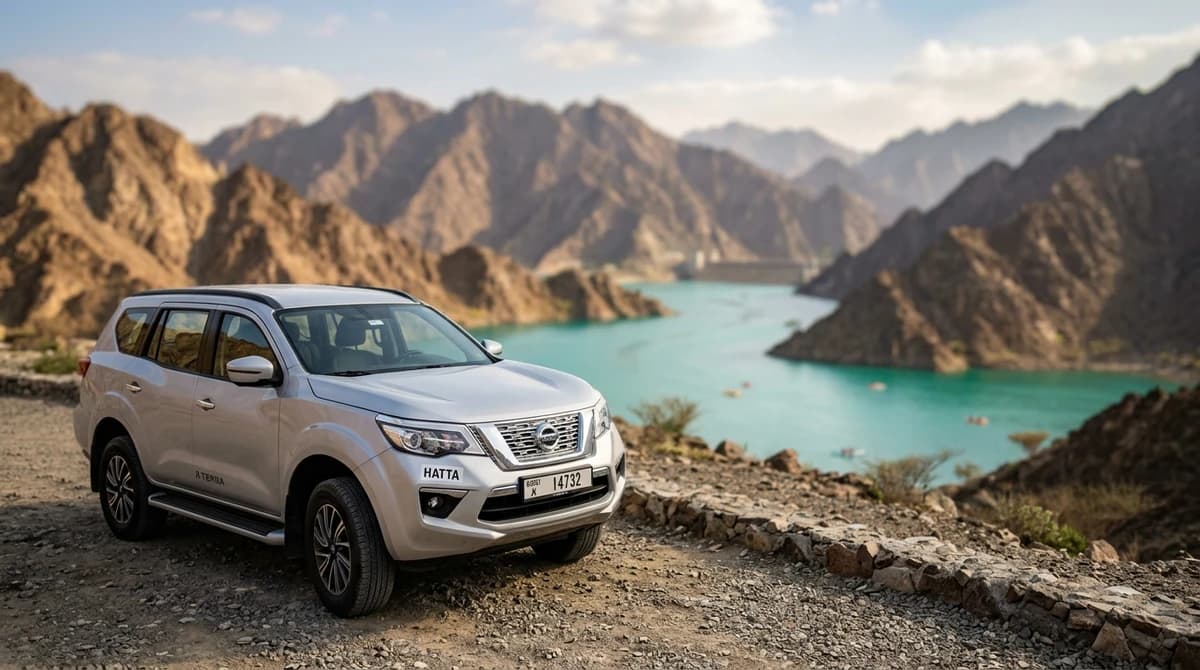
You don't need an SUV for a Dubai to Hatta road trip. You do need to leave the E44 at Al Madam, because the road that carries straight on runs through Oman, and a UAE rental's insurance stops at that checkpoint. Get those two things right and the rest is an easy 90 minutes. This post runs the trip in the order you'll drive it: the route and the border, the distance, the car, the stops and their parking, the season, and the fuel and kilometre sums. The Oman crossing at the far end of Hatta gets its own answer in the FAQ.
The route, and where the border catches people
Out of the city you take the E44. It starts as Al Khail Road, becomes Ras Al Khor Road, then the Dubai to Hatta Road past Al Aweer, Lehbab and the camel track. That part is a straight dual carriageway with a 120 km/h limit and radars, and it's fine. The problem is at Al Madam, roughly 65 km out. The old E44 continues east from there through the Omani wilayat of Mahdah, past a village called Al Rawdah, and comes back into the UAE at Masfout. There's an Omani checkpoint on it. GCC nationals get waved through. Everyone else is turned back. Even if you weren't, the included insurance on a UAE rental covers the seven emirates and not a metre of Oman, so a scrape on that stretch is entirely yours.
The route that stays in the UAE is the one Hatta's own plan your visit page recommends. From Al Madam go north on the E55 to Mleiha, turn east onto the Sharjah to Kalba road (E102), and follow the Hatta signs off it after Shawka. That road drops you back onto the E44 near Huwaylat and runs through Masfout into Hatta. From Deira or Mirdif it's simpler to take the E611 to Sharjah and join the E102 from the start. Either way, look at the route your map app has drawn. If it shows Mleiha or Shawka you're fine. If it shows Al Rawdah or a border post before Masfout, it has picked the Omani stretch.
One more piece of map confusion. Madha is a different Omani enclave, on the east coast between Khor Fakkan and Fujairah. It's the trap on a Fujairah trip, not this one. The E102 to Kalba is UAE road the whole way. The wider rules for taking a rental into Oman are a separate post, because for this trip the answer is that you don't.
How far it is and how long it takes
From Downtown it's about 130 to 135 km door to door on the E102 routing, and 90 minutes on a quiet morning. Leave at nine on a Saturday and it stretches toward two hours. Most of that is lost on the E44 out of the city and at the Al Madam roundabout. The last 20 km, from the Kalba road turn-off through Huwaylat and Masfout, is where the drive changes. The road climbs into the Hajar foothills, the bends tighten, and the limit drops to 80 and then 60 through the villages. Trucks use it too, and there are radars on the way down as well as up, so don't make up time there.
Hatta town sits at about 300 metres. That isn't high, but the final approach has enough gradient that a small engine notices it. Which brings us to the car.
Which car to take
A standard crossover does this trip without effort. A Geely Coolray or JAC JS4 at AED 109 to 132 a day has the clearance for the speed humps in Hatta town and the AC to keep up on the climb. The boot takes a cool box and two bags. That's our honest pick for two to four people.
Bigger is comfort, not necessity. A Tugella at around AED 286 or a seven-seat Tahoe at AED 439 makes sense if you're five or six with kayak gear and a picnic. It doesn't make the road any more passable, because the road is tarmac the whole way and every stop in this post has a paved car park. If you're picking from the SUVs on our fleet, pick for the number of people, not the terrain.
At the bottom end, a Nissan Sunny at AED 75 will make it. It'll do it slowly in August with four people and the AC on full, and it comes with a 250 km daily allowance, which matters for the sums later. Between October and April, with two of you, it's a perfectly reasonable choice.
What you must not do is go off-road. The gravel tracks off the dam road and the wadi beds behind Wadi Hub look inviting, and some older guides still describe the Hatta track as a 4x4 adventure. In a rental it's a breach of the agreement. Off-road use voids the cover on every car we rent, whatever the badge says. A Tahoe stuck in a wadi with a torn sump is recovered at your cost and repaired at your cost. The rules on off-road driving in a rental are the same for Hatta as for the desert.
What to see and where to park
Four or five stops fill a day comfortably. They're all within about 6 km of the Hatta Fort roundabout, so once you're in you barely drive.
Hatta Dam and the kayaks
Follow the signs past the town to the dam. The car park is paved and sits above the water, with a short walk down to the kayak hire on the shore. Hire runs from roughly AED 60 to 120 per person for an hour, depending on whether you take a single, a double or a pedal boat. It's the one thing in Hatta worth booking ahead on a winter weekend. Go early. By eleven on a Saturday the car park is full, and the overflow means parking on the approach road and walking. Next to the dam is the newer Hatta Sustainable Waterfalls area, which shares the same parking.
Hatta Wadi Hub
About 3 km from the fort roundabout, with a large free car park at the gate. It opens at nine and closes at seven. The mountain bike centre, archery, ziplines and the drop slides are each priced per activity, and there are food trucks on site, so lunch here is easy. In summer the adrenaline activities cut back or close, so check the day's schedule before you drive out for one thing in particular.
Hatta Heritage Village
Free to enter, in the middle of town, with parking on the street outside and a small lot. The restored fort and watchtowers take about 45 minutes, and the falaj running through the palms is the coolest spot in Hatta on a warm afternoon. Do it after the dam rather than before, because the dam car park fills first.
Hatta Hill Park
A short, steep road winds up to the park on the hill above the town, with a viewing platform at the top. There's parking at the bottom and a smaller area near the top. The drive up is the one place a Sunny loaded with four people will be in second gear. Late afternoon is the time, when the heat has gone off the valley.
The honey bee garden
The Hatta Honey Bee Garden and Discovery Centre is a seasonal stop, open through the cooler months and shut in summer, with a small entry charge and its own parking. It's worth an hour with children, and the shop sells local Sidr honey if you want something to take back.
When to go
October to April is the season, and November to February is the sweet spot, with daytime highs in the low to mid twenties in the valley. In July and August it hits 45 degrees down by the dam and the kayak hire runs only in the early morning. You can do the drive in summer, but you'll spend the day moving between air-conditioned spaces.
Fridays and Saturdays in winter are busy. If you can go midweek, do. If you can't, be at the dam by nine and leave the rest of the loop for after lunch.
Fuel and the kilometre allowance
Fill up before you leave Dubai. There are stations on the E44 as far as Al Madam and a station in Hatta itself, but the stretch between them on the Kalba road is thin. Fuel costs the same everywhere in the UAE, so there's nothing to gain by waiting.
Now the sum that most guides skip. The round trip from Downtown is about 265 km on the E102 routing. Add the loop around Hatta, the dam, Wadi Hub, the Hill Park and the town, and you're at 285 to 295 km. That fits inside a 300 km daily allowance with almost nothing to spare, and it's 40 km or so over a 250 km one. Check which figure your car carries before you book. The two cheapest cars on most fleets, ours included, are the ones on 250. If you're over, the extra kilometres are charged at the per-km rate on your agreement. That's not a disaster, but it's better known in advance. The mileage allowance and fuel policy post covers how it's read from the odometer at return.
Fuel is same-to-same on our cars, so what you bring back is what you started with. And if the car breaks down out here, call us from the town where you have signal, not the wadi where you don't. Recovery from Hatta is a two to three hour job. Hatta is the gentlest of the road trips from Dubai, and the one to do first if you're new to driving here.
FAQ — Common Questions Answered.
How far is Hatta from Dubai by car?
About 130 to 135 km from Downtown on the route that stays inside the UAE, which is the E44 to Al Madam, then the Sharjah to Kalba road and the Hatta turn-off. Allow 90 minutes on a quiet morning and up to two hours on a winter weekend. The straight-on E44 through Oman looks a few kilometres shorter on a map. Non-GCC nationals are turned back at its checkpoint, and your rental insurance wouldn't cover the stretch anyway. Coming back you can expect the same time, with the Al Madam roundabout the slow point.
Do I need an SUV to drive to Hatta?
No. The road is tarmac from Dubai to every attraction, and a standard crossover or even a small saloon handles the climb. An SUV buys you space and a higher seat, which is worth paying for with five or six people or a lot of gear. It doesn't buy you any right to leave the tarmac, because off-road use is a breach of the rental agreement whatever you're driving. If you're choosing between two cars, pick the one with the 300 km allowance over the one with 250.
Does the road to Hatta cross into Oman?
The old E44 does, between Al Madam and Masfout, and you should avoid it. The recommended route via the Sharjah to Kalba road is UAE territory the whole way, with no checkpoint. At the far end of Hatta town is the Al Wajajah crossing into Oman, and a rental car doesn't go through it on a day trip. You'd need written approval from us before you travel and an Oman insurance extension arranged in advance. Without both, the car isn't covered past the barrier.