

Can You Take a Rental Car Off-Road in Dubai? Desert Driving Rules
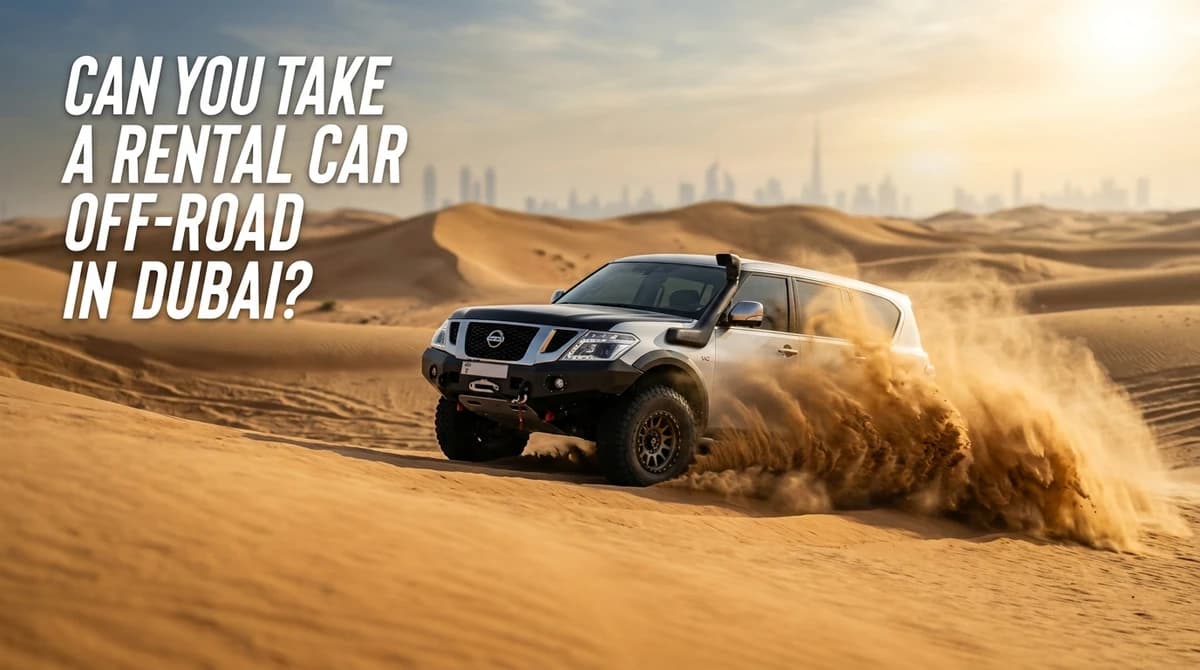
No. A standard rental car in Dubai stays on the tarmac, and the SUV badge on the tailgate doesn't change that. Take one onto the sand anyway and the included insurance is void from the first metre. The recovery truck, the underbody repair and, if it rolls, the whole car land on your card. That's the agreement at every mainstream company here, ours included. So the answer to whether you can take a rental car off-road in Dubai is short. The useful part is what counts as off-road, how the company finds out, and what the bill looks like. Then the ways into the desert that don't end with you paying for a car you don't own.
What the agreement says
The rental agreement, usually under prohibited use, says the car is for paved public roads. Off-road driving sits in the same list as racing, drink driving and handing the keys to someone who isn't on the agreement. Each is a breach, and a breach voids the cover. That's the part people miss. The insurer doesn't pay less for desert damage. It pays nothing, the waiver you bought at checkout is irrelevant, and the rental company recovers the full repair from you.
Our agreement works the same way. The included insurance holds in all seven emirates, on the road, and the list of ways renters void the insurance has off-road use near the top. The 24/7 breakdown line and the replacement car are for road use too. A car sunk to its sills near Lehbab isn't a breakdown. It's a recovery job at your expense.
What counts as off-road
The rule is simpler than people want it to be. Any surface that isn't paved counts, whether or not you'd call it off-roading. That includes:
- The dunes, from the small ones behind Al Qudra to Big Red and Fossil Rock on the Hatta road.
- Wadi beds and the gravel tracks around Hatta, including the side tracks to the pools.
- The sand tracks that fan out from the Al Qudra cycle path towards the lakes.
- Beach sand. A saloon on the beach at Jebel Ali sticks as surely as one on a dune, and the salt does its own damage.
- The graded track to a desert camp. The camp sent you a pin and the track looks flat, but it's unpaved, and a good share of "we only went a little way" calls start there.
And what isn't off-road, where you can take the car without a second thought:
- The paved Al Qudra road and the car parks by the lakes. Drive in, park on the tarmac, walk the rest.
- The Hatta Dam car park and the road up to it.
- The mountain roads to Jebel Jais and Jebel Hafeet. Both are proper paved climbs with barriers, and both are on our list of road trips from Dubai.
- The E44 to Hatta itself. Only the tracks off it are the problem, and the Hatta road trip guide says which turnings to ignore.
If the surface changes colour and the tyres start making a different noise, you've left the agreement. That's the whole test.
Why every company has the rule
Two reasons. The first is what sand does to a road car. Rental SUVs are mostly two-wheel-drive crossovers on highway tyres. A Geely Coolray or a JAC JS4 has hatchback ground clearance under a taller body. On soft sand at road pressure it's stuck within a few metres, and by then the transmission has been cooking. The sand it collects stays in the undertray and the wheel bearings for weeks.
The second is the insurer. UAE motor policies exclude off-road use, so a rental company can't cover what its own insurer won't. Making it a breach is the only protection the fleet has. That isn't a Bintali quirk. It's the market.
How the company finds out
People assume nobody's watching in the desert. It's closer to the opposite.
Most stuck cars aren't dug out by their drivers, so a truck comes. Either you ring the rental company, which is reporting yourself, or a private recovery firm, which wants the registration and the agreement before it hooks up. Then the return check. Sand packs into the door sills and the spare-wheel well, and the person checking the car in looks there on purpose. Many companies fit GPS trackers, and the log shows a car stationary 4 km from the nearest road for two hours. And the damage talks. Sand in the brake discs, or a slipping clutch on a car that was new in spring. A mechanic reads that in a minute.
What it costs when it goes wrong
Market figures, because the bill depends on how far in you got and what broke.
Desert recovery runs about AED 300 to 1,500. The low end is a truck winching you off a track near Al Qudra in daylight. The high end is a night job 10 km past Lehbab, or a second truck because the first one got stuck too. That only gets the car back to the tarmac.
Then the repair. A new undertray and sump guard is a few hundred dirhams. A burnt clutch or a transmission full of sand runs into the low thousands. Suspension or driveshaft damage from a hard landing off a dune crest goes past that. A rolled car, which is how a fair number of first attempts end, is billed at its full value. On a Chevrolet Tahoe that's a six-figure sum.
None of this touches the excess, because there's no excess on a breach. The deposit hold of around AED 1,500 covers the recovery truck and not much else. The balance goes to the card on the agreement, and the post on rental car damage charges shows how that bill is built.
How to get into the sand properly
The desert is worth a day. Just not in a car you rented for the city.
A desert safari with a licensed operator is what most visitors want in the end. The operator's Land Cruiser is insured for sand, the driver does it every day, and if it gets stuck it's their problem. Shared evening trips run about AED 150 to 400 a person at market rates.
A dedicated off-road rental from a specialist is the only rental where the answer is yes. A handful of companies rent proper 4x4s, mostly Jeeps and Patrols, with off-road cover written into the agreement and a briefing on where you can go. The rate and the deposit are higher, and the cover still has exclusions, so read what the yes leaves out.
A guided self-drive dune experience puts you at the wheel of the operator's 4x4, in convoy behind a guide. It's the middle option if you'd rather drive than be driven.
A club run in a friend's car works if you know a resident with a Patrol or a Land Cruiser. The off-road clubs take beginners out most winter weekends, with recovery gear and people who know how to use it.
If you're going in a proper 4x4 anyway
For the few with a real 4x4 and permission to use it, the basics:
- Drop the tyres to about 15 psi before you leave the tarmac, and carry a compressor to bring them back up before the highway.
- Never go alone. Two cars minimum, so one can pull the other out.
- Water, more than you think, plus a shovel and a tow strap.
- Start near Al Qudra or Lehbab, where there's phone signal and the road is a few kilometres away, not in the deep sand towards Sweihan.
- Tell someone your plan, and put the Dubai Police app on your phone. Its SOS function sends your location.
Dubai Police carried out 4,870 rescues in six months in the first half of 2026, and only four were vehicles trapped in sand. That's not because few cars get stuck. The ones that end well are pulled out by the second car before anyone calls 999.
So what is the SUV for?
Paved roads, and there are plenty of good ones. The reason to take an SUV out of Dubai isn't sand. It's the climb to Jebel Jais with four people and luggage, or the E44 to Hatta in August with the air conditioning working hard. A Volkswagen T-Roc at about AED 198 a day or an Exeed TXL at around AED 308 does all of that. Every car on our SUV rental in Dubai page carries the same on-road condition, the Tahoe included. Choose on space and comfort, not on what the brochure says it can climb.
FAQ — Common Questions Answered.
Is off-road driving allowed in a rental car in Dubai?
No, not on a standard rental from any mainstream company, and the full-cover waiver doesn't change it. Off-road use is a breach of the agreement, which voids the included insurance and makes you liable for recovery and the full repair. The rule covers any unpaved surface, so wadi tracks, beach sand and the track to a desert camp count as much as the dunes do. The only rentals that allow it are specialist off-road companies renting proper 4x4s with off-road cover written into the agreement. If you want the dunes, that or a safari is the route.
Does rental car insurance cover desert driving?
No. UAE motor policies exclude off-road use, and rental agreements treat it as a breach, so the moment the car leaves the tarmac you're uninsured. The waiver or CDW you added at checkout only reduces the excess on an insured accident, and there's no insured accident here. You pay the recovery truck, the repair and, if the car rolls, its full value. Travel insurance won't step in either, because it reimburses an excess, not a breach.
Which SUV can I rent for the desert?
None of the SUVs on a standard rental fleet, ours included, because every one of them carries the same on-road condition whatever its badge says. A Tahoe on road tyres sinks as readily as a Coolray once the sand is soft. Rent an SUV for the mountain roads to Jebel Jais and Hatta, where the space and the climbing power earn their money. For the sand, book a safari or a specialist off-road rental with a real 4x4 and cover that says so.