

Car Rental Scams in Dubai: Red Flags and How to Verify a Company
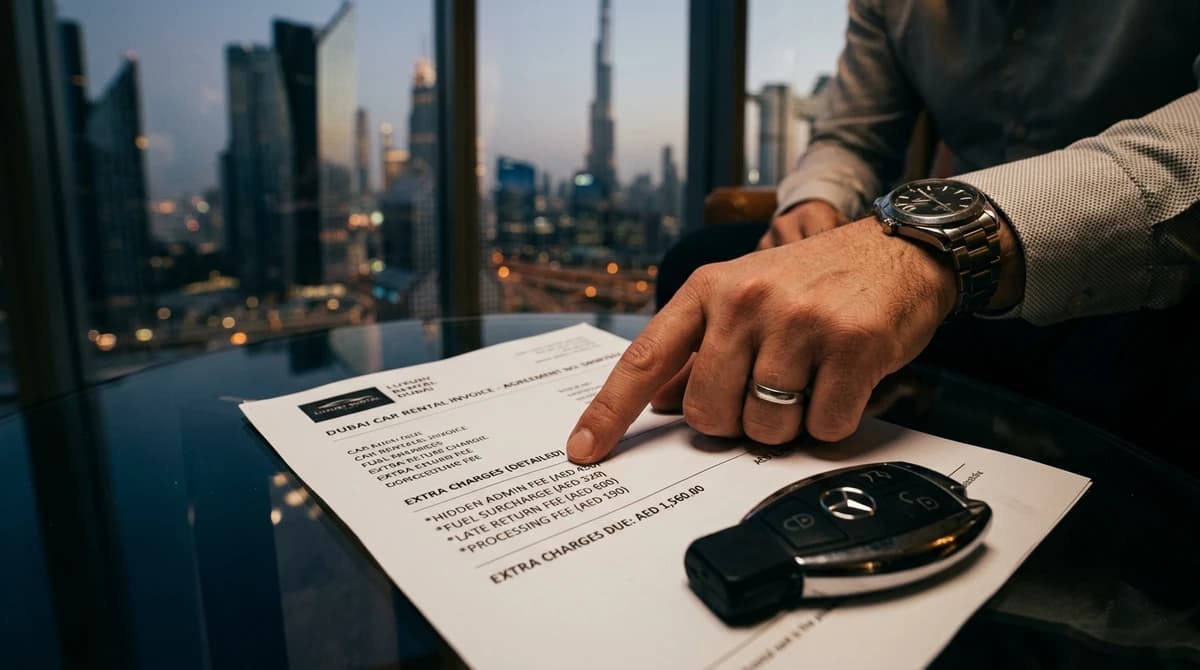
Almost every car rental scam in Dubai starts with a real car, a real person on WhatsApp and a real price, usually a good one. The rest of the numbers are missing: the excess, how the deposit is taken, what gets added to a fine, and the name of the company that owns the car. Those turn up once you're beside the car with your bags, when the price has moved and you've nowhere else to be. Outright fraud, the website that takes a prepayment for a car that doesn't exist, is rarer and easier to spot. This post covers both: the ways a rental goes wrong, the signs in a listing or a chat, the ten-minute checks, and where to go if you've already paid.
How a Dubai rental goes wrong
Before you pay
The too-cheap listing. A Nissan Sunny at AED 55 a day on an Instagram page or a classifieds site, when the same car books at AED 75 to 90 from a company with an office. The price is real, for a car that has already gone out. When you message, that one was "just booked" and the one available is AED 110. Or the AED 55 stands, but the deposit has grown to AED 3,000 and the mileage cap has shrunk to 150 km a day. You've told your family you have a car. Most people take the AED 110.
The company that exists only in a chat. There's a brand name, a logo, a folder of fleet photos and a mobile number. No address, no landline, no trade licence number, and no website beyond a link in the bio. Some of these are one person with three cars, and some of those people are fine. But if the deposit goes missing there's no office to walk into and no legal name to put on a complaint.
The aggregator page where the supplier is somebody else. The marketplace shows a car, a price and its own logo. The car belongs to a supplier whose name appears, if it appears at all, on the confirmation email. You've read the platform's reviews, not the supplier's, and the supplier is the one holding your deposit. More on that further down.
At handover
The private car with no rental insurance. Someone is renting out their own car, or a friend's, or a car they're still paying off. It carries private insurance, and private insurance doesn't cover a vehicle that's been hired out. Put it into a barrier and the insurer declines the claim, and you're negotiating the repair bill with the owner in person. The registration card, the mulkiya, names the owner. If that's a person rather than a company, walk away.
The free upgrade with a bigger excess. The hatchback you booked "isn't available", so you get the SUV at the same price. Generous, until the agreement shows an excess of AED 5,000 instead of AED 1,500, plus the age and licence conditions that come with a higher-value car. An upgrade is only free if the excess and the conditions stay where they were. Ask before you take the keys.
The deposit charged instead of held. On a hold, your bank blocks the money and it reappears when the block lapses. On a charge, the money has left your account and comes back only when the company sends it, on the company's timetable. Dubai's Department of Economy and Tourism told rental companies in 2024 that deposits must be blocked, not charged, and returned within 30 days. A company that charges anyway has turned your refund into a favour. A cash deposit is the same problem without the card statement to argue from, which is why nobody should pay one.
At return
The damage you didn't do. Someone walks round the car, finds a scuff on the rear bumper and quotes AED 800 from the deposit. You have no photo of that bumper from handover, so it's your word against theirs, and they have the money. This is the complaint that turns up most often in reviews of Dubai rental companies, and the easiest one to prevent. Photograph every panel, the wheels, the glass and the fuel gauge before you drive off. Then send the photos to the company in the chat, so both sides hold the same evidence. The handover checklist sets out the full routine, and how damage is charged explains what a legitimate claim looks like when one does arrive.
The fee on top of the fine. A Salik crossing costs AED 4.20 off peak and AED 6.30 at peak, VAT included. A speeding fine costs whatever Dubai Police issued. Some companies add AED 1 to 2 to every crossing and AED 50 or more to every fine, and tell you when the deposit comes back short. That's legal if it's printed in the agreement you signed and padding if it isn't. The full list of hidden fees is a separate post. The point here is to ask what's added to a fine before you pay, and to keep the answer.
Red flags in a listing or a chat
None of these proves anything on its own. One is a question to ask, and three together is the answer.
- A price well below what companies with offices charge for the same car. Under AED 70 a day for a recent economy car is where to start asking.
- No physical address, or an address that turns out to be a residential tower or a PO box.
- A mobile number and nothing else. No landline, no email on a company domain.
- "DM for price" on a car that should simply have a rate.
- A deposit payable in cash, or by transfer to an individual's bank account.
- No excess, mileage allowance or fuel policy anywhere in the listing, and a vague answer when you ask.
- An agreement you'll see for the first time at handover.
- Reviews that are all five stars, all recent and all one line. Real reviews name a person, a car, a problem and how it was sorted.
- Pressure. "Last one", "price valid today", "pay now to hold it".
How to check a company in ten minutes
- Ask for the trade licence number and the legal name. Dubai mainland companies are licensed by the Department of Economy and Tourism, and you can look them up by name or licence number on the Invest in Dubai business directory. You want an active licence with car rental among its activities. The legal name often differs from the brand on the Instagram page, which is why you ask for it rather than searching the handle. Free zone companies are licensed by their own free zone, which keeps its own register.
- Ask who owns the car. A rental fleet is registered to the rental company, so the owner on the mulkiya should be the company on your agreement. Ask for a photo of it before you pay and check it against the plate at handover.
- Find the office on the map, then call it. A landline that's answered, or a WhatsApp Business profile with the address and hours filled in, tells you more than the follower count.
- Get the agreement or the published terms before any money moves. The excess, the deposit and how it's taken, the mileage allowance, the fuel policy and what's added to Salik and fines should all be printed. A promise in a chat is not a term.
- Confirm the deposit is a hold on a card in your name. If the answer is cash, a transfer, or "we refund it after 21 days", stop there. How the deposit works at a straight company is worth knowing before you compare.
- Read the reviews for detail rather than the score. Look for the two-star ones and see how the company answered. A company that replies to complaints with a name and a resolution is one you can reach when something goes wrong.
That's the whole check. If a company passes all six, the worst you're likely to face is a slow deposit release, and you'll have the paperwork to chase it.
Marketplace or direct?
The marketplaces and aggregators have earned their place. You see fifty suppliers on one screen, the prices are usually honest for the base rate, and a platform promotion can undercut booking direct. For a short tourist rental paid on a credit card, a known platform is a reasonable way to find the car.
The trade-offs sit underneath the price. Your contract is with the supplier, not the platform, so the supplier sets the excess, takes the deposit and decides what's added to a fine. The figure on the page is often the daily rate alone, with the deposit, the excess and any delivery fee waiting on the supplier's own terms. When a refund is owed, the request runs through the middleman, and both sides can point at each other while your money sits between them. And the supplier can be a company you've never heard of, trading under the platform's branding until the confirmation email arrives.
So use the marketplace to find the price, then check the supplier exactly as you would if booking direct. If the supplier's legal name isn't visible before you pay, book direct instead. The direct price is usually within AED 10 to 20 a day of the platform's. For a monthly rental, go direct every time. You'll be dealing with the company for weeks, and you want to know whose office you're walking into. Whether a rental is the right call at all is a separate question, and renting versus taxis and Metro works through that one.
If you've already paid
Write to the company first. State the amount, the date the car came back, what you're owed, and a deadline a week out. Attach the agreement, the handover photos and the return confirmation. A lot of disputes end here, because the company can see you have the evidence.
If the deadline passes, file with Dubai Consumer, the consumer protection arm of the Department of Economy and Tourism, online at consumerrights.gov.ae or by phone on 600 545555. Attach the same file. The consumer rights in the UAE include the right to the declared price and to accurate information. A deposit held past 30 days, or a fee that never appeared in your agreement, falls inside that. The department can pressure a company and usually does, though it can't seize your money back.
If the deposit was charged rather than held, go to your card issuer as well. A chargeback puts the burden on the merchant to justify the charge. A rental company that can't produce a signed damage report or a fine notice tends to refund before the deadline rather than argue. Card rules apply whatever the local process is doing, and the clock is shorter than you think, typically 120 days from the charge.
If the car never existed, the documents were forged or a prepayment vanished with the account that took it, that's fraud rather than a dispute. Report it to Dubai Police through any station, the Dubai Police app, or its eCrime platform for online fraud, and keep the chat, the payment receipt and the listing screenshots.
We run 114 cars from one branch at Nad Al Sheba 1. The phone number and email are published on the site, and the line is answered 24 hours a day. The terms are on the site too, and the fees show at checkout before you pay. The deposit is a hold on your card rather than a charge, and traffic fines are passed on at the amount Dubai Police issued, with no admin fee. If that's the paper trail you'd rather have, our listings show each car's rate, mileage allowance and VAT-inclusive total before you enter a card.
FAQ — Common Questions Answered.
Are the cheap car rental deals in Dubai legitimate?
Some are, and the price alone won't tell you which. A licensed company can put an older Nissan Sunny or Mitsubishi Attrage out at AED 75 a day with 250 km, so a rate around there is normal. A weekly or monthly plan brings the daily figure lower still. A listing well under that, with no address and no excess or deposit printed anywhere, is where the bait-and-switch lives. Ask for the total for your dates including VAT, the deposit amount and how it's taken, and the excess, all in writing before you pay. A real deal survives those three questions, and a fake one changes shape.
How do I check whether a car rental company in Dubai is licensed?
Ask for the trade licence number and the legal name, then search the Invest in Dubai business directory, which lists mainland companies licensed by the Department of Economy and Tourism. You're looking for an active licence with car rental among its activities and a name that matches the agreement you'll be asked to sign. Free zone companies won't appear there because each free zone keeps its own register, so ask which one issued the licence. As a second check, ask for a photo of the mulkiya of the car you'll get, and confirm the owner is the company and not an individual. If a company won't share a licence number, you have your answer.
Is it safer to book through a marketplace or directly with the company?
Direct, if you can verify the company, because you know who holds your deposit and whose office to visit if something goes wrong. A marketplace is fine for finding the price, and for a short rental on a credit card. The condition is that the supplier's name is shown before you pay, and that you check that supplier as you would any other. The platform's reviews and refund process don't replace the supplier's terms, which are what govern the excess, the fees and the deposit. For a monthly rental, book direct every time.