

Rental Car Handover Checklist: What to Check Before You Drive Off
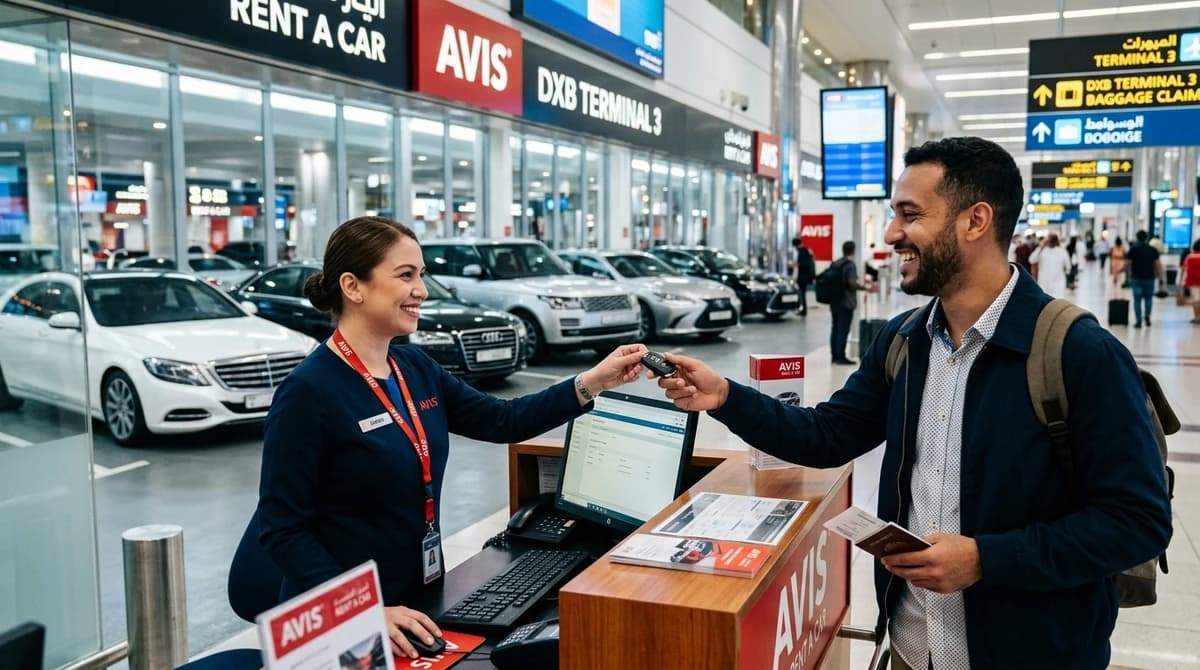
The driver has just handed you the keys outside your hotel, or by the taxi rank at Terminal 1. He's waiting to photograph the fuel gauge and get your signature. You've got your phone in your hand and about five minutes. Used well, those five minutes are the difference between a deposit that comes back in full and a bumper scuff nobody photographed being taken out of it three weeks later. This rental car handover checklist for Dubai is what we'd run through if it were our own money on the line. It covers the papers in the glovebox, what to photograph, the checks you can only do at the kerb, and what the form you sign commits you to.
What should already be in the car
Before you look at a single scratch, open the glovebox. Three things live there, and two of them can cost you if they're missing.
The mulkiya is the registration card, a credit-card-sized card carrying the plate number, the chassis number and an expiry date. Police can ask for it at any stop. Driving without it is an AED 400 fine on the federal traffic violations list, and although it's the rental company's card, the fine lands on whoever is driving. Check the expiry date too. A card that runs out mid-rental is a car that shouldn't be on the road.
Next to it should be a copy of the insurance certificate and a copy of the rental agreement with your name on it. At a checkpoint or after an accident, the agreement is what proves the car is legitimately in your hands. Without it you're driving someone else's car with no paper trail.
Then look up at the windscreen. The Salik tag is a small sticker, usually behind the mirror or near the top edge on the passenger side. Every toll gate reads it, and each crossing is billed to the car and then to you at AED 4.20 to 6.30 a time. If there's no tag, or it's peeling off, say so now. A car that passes a gate without a working tag collects a violation against its plate, and that ends up on your bill. How crossings are billed on a rental is in our Salik charges guide.
Our driver will want your originals at this point as well: licence, passport or Emirates ID, and the card the deposit sits on. Uploading copies at booking got the car delivered, but the driver still has to hold the real licence before he leaves you with it. The full list is in the requirements to rent a car guide.
The walk-round
This is the part most people rush, and it's the part that decides the deposit. Walk the car once with our driver and once on your own with the camera running.
Photograph, in this order:
- Four corner shots. Stand at each corner and take the whole car diagonally so two sides are in frame. These tie every close-up to this car on this day.
- Each panel straight on. Doors, wings, bonnet, boot, roof. Roofs get missed, and they collect dents from car-park barriers and things dropped from balconies.
- Both bumpers, low. Crouch. Scuffs on the lower edge of a bumper are the most common return dispute we see, and they're invisible from standing height.
- All four wheels and the tyre sidewalls. Kerb rash on an alloy is billed as damage, and it's easy to pin on you if no photo shows it was there first.
- The windscreen, from inside and out. Gravel on the E11 and E311 chips glass constantly, and a crack spreading from an old chip becomes an argument about whose chip it was.
- Anything you find. Get in close with a key or a finger next to it for scale, then step back and take one shot that shows where on the car it sits.
Then take a slow lap on video, a minute at most, with the plate in the first frame. Video timestamps itself and is very hard to argue with.
Make sure your phone is saving the date and time into the image data, because a photo with no time proves nothing. And keep all of it until the deposit is back, which is 15 to 25 days after return. Any dispute arrives in that window.
Inside the car
Sit in the driver's seat, start the engine and leave it running while you go through these.
- Warning lights. Everything lights up on start and then goes out. A check-engine or tyre-pressure light that stays on is our problem to fix, but only if you raise it now.
- The odometer. Photograph the reading. Your allowance is 250 or 300 km a day on most of our cars, and any extra-kilometre charge is worked out from this number against the one at return. If the form says something different from the dash, have it corrected before you sign.
- Fuel. Photograph the gauge with the engine on. We hand over same-to-same and photograph the level ourselves, so your shot and ours should agree. Return it lower and you pay the difference at cost.
- The air conditioning. Set it to full cold and hold your hand over a vent for thirty seconds. Blowing air is not the same as cold air. In July a tired compressor shows itself on the first stretch of Sheikh Zayed Road, and by then you own the problem for the week.
- The tint. Side and rear glass can be tinted to 50 percent, the windscreen can't be tinted at all, and a car over the limit carries an AED 1,500 fine. Rental cars come in legal, but if the glass looks like limousine glass, ask.
- Spare wheel or repair kit. Lift the boot floor. Plenty of newer cars carry a compressor and sealant instead of a spare, and you want to know which before you're on the E44 at night. A flat from normal wear is on us. Wrecking the rim by driving on it is on you.
- Seats and trim. A stain or a cigarette burn that isn't on record becomes a deep-clean charge.
- Child seat, if you asked for one. Check it's fitted and the belt path is right. Children under four need one by law.
- Phone connection. Most of our cars have Apple CarPlay or Android Auto and none carry a separate GPS unit, so plug in now and confirm the map shows on the screen.
If the car has a dash cam, ask whether it's recording. Keep any footage as evidence after an accident, and don't post it online, which can be an offence under UAE law.
The form you sign
The handover form has three parts that matter, and most people sign all three without reading any of them.
The damage diagram is the outline of a car with marks on it. Every mark is a scratch or dent the company has already recorded, and anything not on the diagram is, as far as the paperwork is concerned, undamaged when the car left you. So hold the diagram against what you found on the walk-round. Missing mark? Ask the driver to add it and initial it. Ours do this on the spot. If anyone ever refuses, photograph the mark next to the unsigned form and don't drive off until it's noted.
The odometer and fuel boxes are the baseline for the two most common charges at return, extra kilometres and a fuel top-up. Check both against the dash, not against what the driver read out.
The named-driver line lists who is insured, and only those people are covered. If your partner is going to drive, they go on now, with their own licence checked, or they don't drive. An accident with an unnamed driver at the wheel is a breach of the cover, and at that point the excess is no longer the ceiling on what you owe.
What a scratch, a scuff or a cracked windscreen tends to cost when it does go through is covered in rental car damage charges, along with how the return inspection works.
The two-minute version
If the driver is double-parked and hotel security is already waving, do these and nothing else:
- Four corner photos and one video lap with the plate in shot.
- Close-ups of both bumpers and all four wheels.
- Odometer and fuel gauge, engine running.
- Hand on the AC vent.
- Glovebox for the mulkiya and the agreement, windscreen for the Salik tag.
- Compare the damage diagram to your photos, then sign.
Everything else on this page is worth doing. Those six are what the deposit conversation comes down to.
A handover that starts this way usually ends quietly: car back, photos compared, deposit released. When it doesn't, our guide to rental car problems covers breakdowns, accidents and charges you don't recognise. If you're still choosing the car, every model we have is listed with its rate and kilometre allowance on our Dubai fleet page.
FAQ — Common Questions Answered.
What should I photograph when I collect a rental car?
You should photograph the whole car from all four corners, each panel straight on, both bumpers from a crouch, all four wheels, the windscreen, the odometer and the fuel gauge, plus a close-up and a wide shot of every mark you find. Then take a short video lap with the number plate in the first frame. Check the photos carry a date and time, and keep them until your deposit has been released, which is 15 to 25 days after return.
What documents should be in the car?
The registration card (mulkiya), a copy of the insurance certificate and a copy of your rental agreement should all be in the glovebox. The mulkiya is the one the police ask for, and driving without it is an AED 400 fine. Your own licence and ID stay with you, not in the car.
What if the Salik tag is missing?
Tell the driver before you go anywhere, and get it in writing on the handover form or in a message to the company. Without a tag the gates on Sheikh Zayed Road and the bridges record the plate, and the crossings come back as violations rather than the normal AED 4.20 to 6.30 toll. If you only notice later, avoid the gates until it's fixed and message the company that day so the timing is on record.
I found a scratch after I drove off. What do I do?
You should photograph it immediately, with the location and time visible, and send it to the company the same day. A mark reported within an hour of delivery from your hotel car park is treated very differently from one that turns up at return. It won't always be removed from the record, but a timestamped photo and a message make it hard to charge you for it.