

Renting and Driving a Car in Dubai During Ramadan and Eid
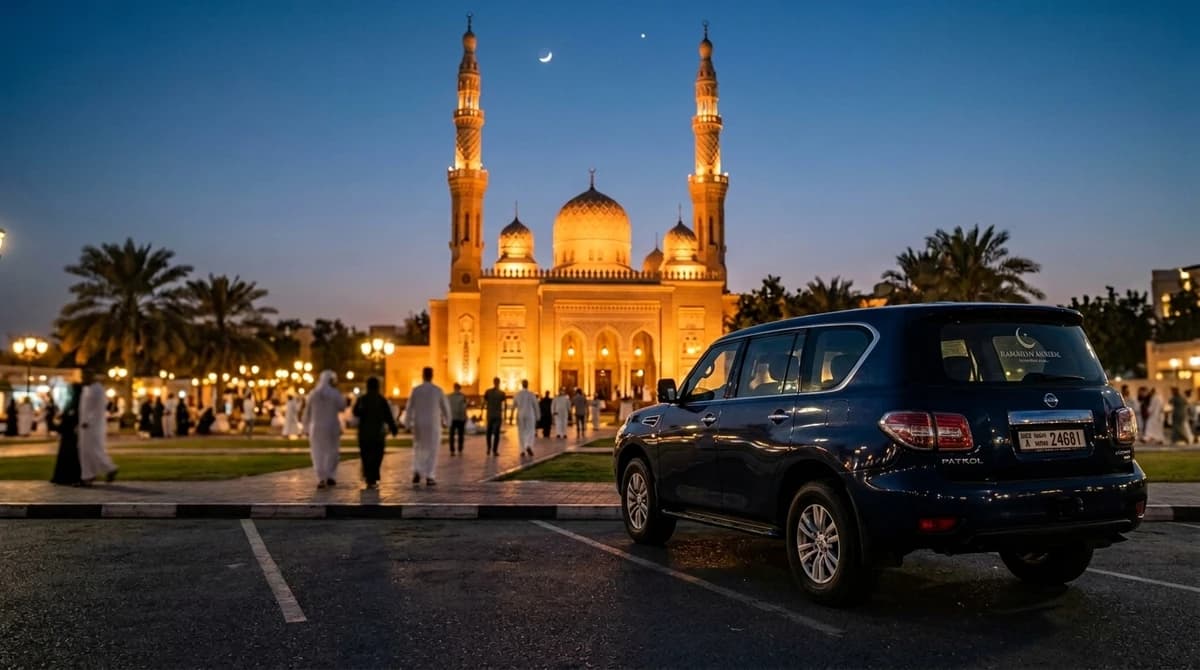
For a driver, Ramadan changes the last hour before sunset and the hours that Salik and paid parking keep. It doesn't change the rental. Car rental in Dubai during Ramadan runs on the same documents and the same deposit as any other month, and the car still comes to your hotel. What's different is when you'd choose to be on the road and what you do about lunch while you're in the car. And if your dates touch Eid, how much earlier you need to book.
This post takes those in turn, then deals with Eid on its own, because Eid is a different problem from Ramadan. One is a quiet month. The other is the busiest driving week of the year.
What changes on the road
The month runs on a different clock. Working hours drop by two hours by law, so the afternoon commute starts around 2pm instead of 5pm, and it doesn't thin out. It builds all the way to sunset. The last 45 minutes before iftar are the ones to avoid. People who've had no food or water since dawn are trying to get home, and patience runs short in exactly the way you'd expect. An insurer's claims analysis reported in The National in February 2026 put 17 per cent of Ramadan accidents between 2pm and 4pm. Another 15 per cent fell between 4pm and 6pm. Dubai Police run a campaign against the same thing every year. In 2026 it was called Ramadan Without Accidents, and officers handed out iftar boxes at seven junctions just before sunset so drivers would pull over rather than race the clock.
The rest of the day is easier than usual. Mornings before 10am are quieter than a normal working day, because a lot of the city was up for suhoor and went back to bed. Midday is calm. Then, after iftar, everything opens at once. Malls stay open past midnight and restaurants run a second seating around 10pm, so the roads around Downtown and City Walk fill again between 9pm and 1am. If you're a visitor with no reason to be anywhere at 5.30pm, don't be. Do your driving before lunch or after 8pm and you'll see the best version of the city's roads.
One habit to pick up. Around sunset, cars stop in odd places: on the hard shoulder, at the side of a slip road, outside a mosque with the hazards on. That's someone breaking their fast wherever they happened to be when the call to prayer went. Give them room and go around.
Eating and drinking in the car
For 2026 the rule and the practice have drifted apart, and the practice is what you'll meet.
On paper, Article 313 of the federal penal code still makes eating or drinking in public during fasting hours an offence. The penalty on the page is a fine of up to AED 2,000 or up to a month in jail. In Dubai that law hasn't been the daily reality for years. Restaurants and cafes serve through the day with no curtains across the windows. Khaleej Times and The National both told visitors this year that daytime eating is a matter of discretion rather than a ban. Time Out's 2026 guide went further and said a quiet drink of water on a metro platform no longer earns a fine.
So, in the car. Eating or drinking inside your own car with the doors shut is private, not public, and you won't be stopped for it. Keep it low-key all the same. Don't unwrap a shawarma at a red light next to a fasting driver, and don't hand snacks out of the window in a car park. Keep the water bottle below the window line rather than waving it about. Tinted rear windows help, and most rental cars here have them.
Sharjah is stricter, in law and in mood. Restaurants there still need a municipal permit to serve during fasting hours, and daytime eating in view of others gets a very different reaction than it does in Dubai Marina. If you're driving up the coast for the day, eat before you cross the border or wait until you're inside somewhere that's serving.
Salik and parking run on different hours
Both change for the month, and both are announced a week or two before it starts. Check the year's announcement rather than trusting a blog, including this one.
The pattern is stable, though. In Ramadan 2026, Salik dropped its two rush-hour peaks and ran a single peak from 9am to 5pm, Monday to Saturday. The off-peak rate applied from 7am to 9am and from 5pm to 2am, and the free window moved back to 2am to 7am. Sundays stayed at the flat off-peak rate. Those hours track the way the city moves in that month, with the peak covering the compressed working day and the sunset run home. With the VAT that Salik has charged since June 2026, expect about AED 6.30 in the peak window and AED 4.20 outside it if the same pattern returns. On a rental you pay whatever the gate charged, so the shift matters if you do your driving after 5pm. That crossing is off-peak in Ramadan and peak the rest of the year. The Salik guide has the gates and the normal hours.
Street parking splits into two shifts. In 2026 the paid hours were 8am to 6pm and 8pm to midnight, Monday to Saturday, with a free window from 6pm to 8pm for iftar and Maghrib prayer. Sundays were free. Multi-storey car parks stayed paid around the clock. That midnight cut-off catches people who are used to free parking after 10pm, so read the sign or the Parkin app before you leave the car at 11pm in JBR. The parking guide for tourists covers the zones and how the app works.
Who's open, and when
Government desks shrink. In 2026 federal offices worked 9am to 2.30pm Monday to Thursday and 9am to noon on Friday, and the two-hour reduction applies across the private sector as well. The RTA publishes Ramadan hours for its customer centres too, which only matters if you need a counter, and you don't. The Dubai Police app takes fine payments 24 hours a day and Salik never needed a counter. Malls open later in the morning and close well after midnight.
Rental companies vary. Branch desks generally run a reduced daytime shift and some pause around iftar, so ask before you turn up at 5.45pm to collect keys. What doesn't change is delivery. We bring the car to your hotel or the airport at the time you book, and our phone and WhatsApp line answers 24 hours a day through the month. If you'd rather not deal with a desk at all, you don't have to. If your plans shift, cancellation is free before the delivery time and an extension is priced at the plan you move into, not at a holiday rate.
Eid is the busy week, not Ramadan
Ramadan itself is a quiet month for rentals. Fewer tourists come, the rates hold or dip, and there's usually a decent choice of cars a few days out. Eid is the opposite, and the switch happens overnight.
Eid Al Fitr and Eid Al Adha are the two busiest rental weeks of the year after New Year. Residents get three or four days off, longer with a weekend attached, and leave Dubai by car. GCC visitors drive in or fly in and fill the hotels. The family cars go first: 7-seaters and mid-size SUVs are usually gone a week before the holiday, while the economy hatchbacks last longer. The roads out of the city slow in the same order. The E44 to Hatta, the E311 and E611 north towards Ras Al Khaimah, and the E88 through Masafi to Fujairah all crawl on the first morning of Eid. They crawl again on the last evening, in the other direction. Start at 6am or go on the second day.
If your trip lands on Eid, book the car when you book the flight. That's the whole advice. For a family run to the mountains a 7-seat Chevrolet Tahoe takes two adults, four kids and the cool boxes, and we fit a child seat before delivery on request. The route notes for Hatta, Fujairah and Jebel Jais are in the road trips from Dubai guide.
Dates. Ramadan 2027 is expected to begin on 8 February 2027. Eid Al Fitr is expected on 9 or 10 March 2027, and Eid Al Adha on 16 or 17 May 2027. All three depend on the moon sighting, so the holiday is confirmed only a day or two ahead, and expected is the right word until then. In 2026, Eid Al Adha ran from 27 to 29 May, which is why the late-May bookings went early. The pillar on the best time to rent puts Eid alongside the other peaks in the calendar.
Small courtesies that cost nothing
None of these are rules. They're what a considerate driver does.
- Turn the music down at traffic lights near a mosque around iftar, and again around Taraweeh, the late evening prayer.
- Don't park in a mosque car park or across its exit between about 8pm and 10pm. Taraweeh fills them, and you'll be blocked in as well as in the way.
- If you're heading somewhere formal, an iftar at a hotel or a visit to someone's home, dress in the car before you get out. Shoulders and knees covered goes a long way this month.
- Let the person cutting across three lanes at 6.05pm go. They're late for iftar and you're not.
If you're renting for those dates, every rental car in Dubai we list shows its daily rate and mileage allowance. The Eid weeks are the ones to book earliest.
FAQ — Common Questions Answered.
Can I eat or drink in my rental car during Ramadan?
Yes, inside the car with the doors shut, and you won't be stopped for it in Dubai. The public-eating article is still in the penal code, but Dubai restaurants serve openly through the day. A discreet meal or a drink of water is treated as exactly that. Keep it below the window line, avoid eating at the wheel in traffic, and don't do it at all in Sharjah, where the rule is applied. If you'd rather be sure, pull into a mall car park and eat inside.
Are rental offices open during Ramadan?
Yes, on shorter hours, and the hours vary by company. Most branch desks run a reduced daytime shift and some close briefly around iftar, so confirm the collection time before you go. Delivery to your address and 24-hour phone support run as normal with us, which sidesteps the desk hours altogether. Government offices and RTA centres work shorter days as well, but fines and Salik don't need a counter.
Is Eid a busy time to rent a car in Dubai?
Yes, the busiest after New Year. Residents leave the city by car for three or four days, GCC visitors drive in, and family-size cars book out first, often a week or more ahead. Rates rise and the choice shrinks the closer you get. Book when you book your flight, and if you're planning a mountain or coast day, drive early on the first morning or wait until the second day of the holiday.