

How to Charge a Rental EV in Dubai: Stations, Costs and Range
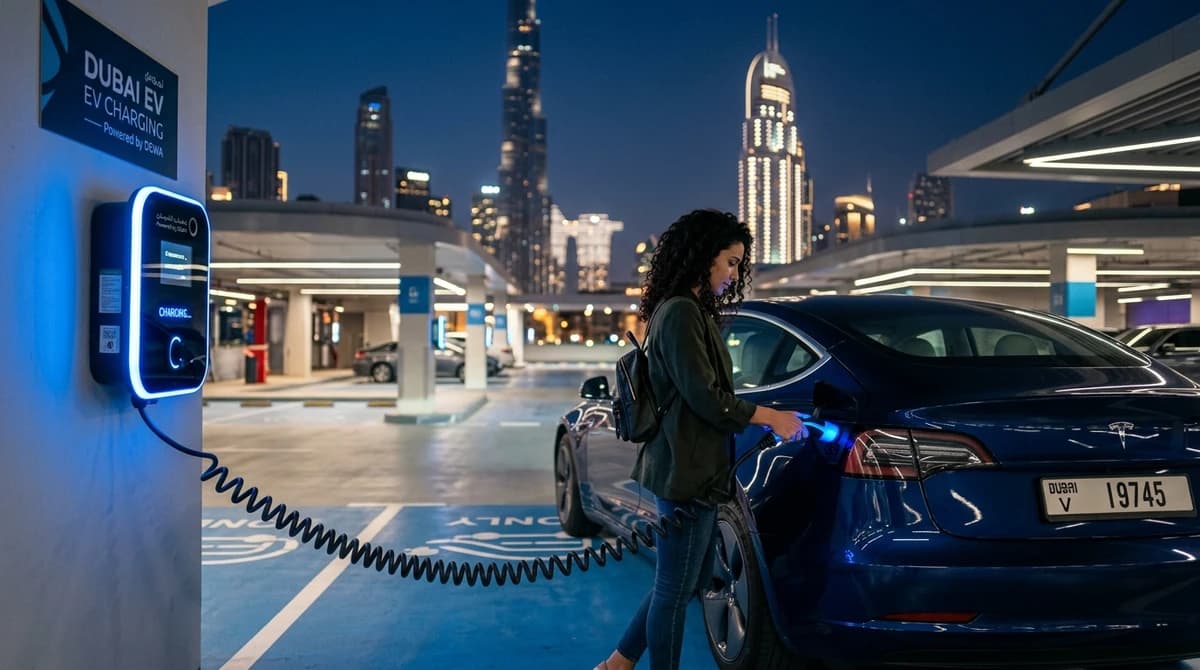
Charging a rental electric car in Dubai is easier than most first-timers expect. DEWA runs more than 1,270 public charging points across the city. Tesla has Superchargers at the big malls and on the motorway to Abu Dhabi. A full battery costs less than half a tank of petrol. The catch is the app. A DEWA charger won't start until you've registered or gone through guest mode, and nobody wants to do that at 11pm with 8 percent showing. Sort it on the first evening. Below is where to plug in and how the connectors work. Then what a charge costs next to Special 95, how far our Teslas really go in the heat, and whether Abu Dhabi and back fits on one charge.
Get the charging app sorted on day one
In a Tesla, Supercharging is handled by the car. You pull in, plug in, and the stall talks to the vehicle. Billing goes to whichever Tesla account the car is linked to, and that's the rental company's arrangement rather than something you set up. Ask at handover how Supercharging is billed on the car you're given, because companies differ. Some absorb it, some deduct it from the deposit. If the account behind the car carries an unpaid balance, the stalls can refuse to start. Right now the question is mostly academic. Tesla made Supercharging free across its UAE sites in March 2026 as a temporary measure with no announced end date. Before that the rate was around AED 1.20 to 1.80 per kWh, and the car's screen shows the live price before you plug in.
For every DEWA charger you need DEWA. Residents open an EV account in the DEWA app with an Emirates ID and the car's registration card. A renter holds neither, so you use guest mode. Scan the QR code on the charger, tap Continue as a Guest, enter your details, verify the email code, pick the charge and pay by card. It takes about five minutes the first time and under a minute after that. Visitors can also open a full EV account with a passport instead of an Emirates ID, but for a week's rental the form isn't worth it. Do the guest flow once at a mall charger while you've got time. Then the card and email are already in place when you actually need a charge.
Where to charge
DEWA Green Chargers
DEWA's network is the backbone. It covers malls, government buildings, petrol forecourts, parks and residential streets, and the map in the DEWA app shows which points are free right now. Four types exist, and it pays to know which one you're standing at. Wall boxes and public posts are 22 kW AC with Type 2 sockets. Fast chargers are 50 kW DC with a tethered CCS2 cable, mostly on petrol forecourts. Ultra-fast chargers are 150 kW DC, and there are far fewer of them. The mall AC posts are the ones you'll use most, because the car charges while you're inside anyway.
Tesla Superchargers
Faster than anything DEWA runs, and in a Tesla they need no app at all. Dubai sites include Dubai Mall in the Zabeel car park, Mall of the Emirates, Al Habtoor City, Wafi City, Abu Hail, Al Warqa and Dubai Hills. The Jebel Ali pair on Sheikh Zayed Road has one block of stalls on each carriageway. The car's navigation shows every site with live stall availability. Route to a Supercharger and it warms the battery on the way, so the charge runs at full speed. Idle fees apply once the car is full and the site is busy, so move it when the app says it's done.
ADNOC, ENOC, malls and hotels
ADNOC opened a 60-point superfast hub at Saih Shuaib on the E11 in January 2026, roughly halfway between Dubai and Abu Dhabi. Inside Abu Dhabi, ADNOC forecourt chargers are common. They run on ADNOC's own system, so that's a second registration, and for a one-day trip I'd skip it and use the Supercharger. Some ENOC forecourts in Dubai host DEWA fast chargers, which work through the same guest flow. Mall car parks are a mix of DEWA posts and Tesla destination chargers. Hotels often have a Tesla destination charger or two, usually free but only for guests. Ask when you check in, because a night on an 11 kW post is a full battery by morning.
Plugging in, step by step
The Teslas on our fleet are UAE-spec cars with a CCS2 port, the European standard, so they take every public charger in the country without an adapter.
- At a Supercharger, reverse in so the cable reaches the rear left of the car. Press the button on the connector to open the flap, plug in, and check the port light turns green. The screen shows the kW and the time to your set limit.
- At a DEWA DC fast or ultra-fast charger, the cable is attached to the unit. Scan the QR code, go through guest mode or your account, plug in, and confirm on the screen.
- At a DEWA 22 kW AC post there's a socket, not a cable. You need the car's own Type 2 cable, which lives in the boot. Check it's there at handover, in the same breath as the battery photo, because a Tesla without its cable can't use any AC post in Dubai.
- Set the charge limit to 80 percent for daily use and 100 percent only the night before a long day. Above 80 percent every charger slows to a crawl, so on a DC unit the last 20 percent takes longer than the first 60 did.
How long it takes depends on the charger far more than the car. Take the Model 3 Performance from 10 to 80 percent. A 250 kW Supercharger does it in about 25 minutes. A DEWA ultra-fast unit takes 30 to 35 minutes, and a 50 kW fast charger a little over an hour. A 22 kW AC post takes about five hours, because the car itself only draws 11 kW on AC. The Model S has a bigger battery: about six hours on AC, 30 minutes on a Supercharger.
What a charge costs against petrol
DEWA ended free charging in 2022, and the current tariff dates from September 2024. Registered users and guests pay the same rate. It's AED 0.70 per kWh on AC chargers and AED 1.20 on DC, plus 5 percent VAT, so AED 0.74 and AED 1.26 at the plug. The figures on Emirates 24/7's guide to the DEWA EV Green Charger card match what the app shows.
Put that on the Model 3 Performance, which has about 79 kWh usable. Filling it from 10 to 100 percent is about 71 kWh, so AED 52 on a mall AC post or AED 90 on a DC fast charger. In this heat on the motorway the car uses about 18 kWh per 100 km. So a hundred kilometres costs AED 13 on AC and AED 23 on DC, and nothing at all while Tesla's free Supercharging lasts.
Now the petrol side, at September 2026's AED 3.69 a litre for Special 95. A Nissan Sunny at about 6.5 litres per 100 km costs AED 24. A mid-size sedan at 8 litres costs AED 30, and a Mustang at 11 litres costs AED 41. So a Tesla charged on AC is cheaper per kilometre than the most fuel-efficient petrol car on the fleet. A Tesla charged only on DC fast chargers is about level with a petrol sedan. The real money sits in the daily rate. That's why the which car to rent guide treats the Tesla as a decision about the car rather than the fuel bill.
How far the Teslas really go in the heat
WLTP figures are Tesla's official European test numbers, and nobody gets them here in August. Our estimate for a July or August day, 45 degrees, air conditioning on and 120 to 140 km/h on the E11, is 25 to 30 percent below the official figure. Recurrent's study of nearly 30,000 cars found average range down 17 to 18 percent once the air temperature passes 38 degrees, before you add motorway speed on top.
| Car on our fleet | Official WLTP range | Our summer motorway estimate |
|---|---|---|
| Tesla Model 3 Performance 2024 | 528 km | 370 to 400 km |
| Tesla Model Y 2023 (Long Range) | 533 km | 370 to 400 km |
| Tesla Model S 2023 (Long Range) | 634 km | 440 to 480 km |
The Model Y figure is for the Long Range version. A rear-wheel-drive Model Y is rated at 455 km, so ask which one you're getting if you plan long days. From November to March, with the air conditioning barely working, you'll see numbers much closer to WLTP.
Dubai to Abu Dhabi on one charge
Yes, and back, without stopping. Downtown Dubai to the Corniche is about 140 km, so the round trip is about 280 km. Leave at 90 percent or above and any of the three cars gets home with something left, even on the summer estimates. The Model 3 Performance lands back at roughly 20 to 25 percent, which is fine, and the Model S doesn't notice.
If you'd rather top up, the options sit on the route. Going south there's the Jebel Ali Supercharger on the Abu Dhabi-bound carriageway of Sheikh Zayed Road, then the ADNOC hub at Saih Shuaib. In Abu Dhabi the Superchargers are at Al Maryah Island, Masdar City and Yas Mall, so a 20-minute stop while you eat covers the return. The Salik gates on Sheikh Zayed Road cost AED 6.30 per crossing at peak and AED 4.20 off-peak, billed to you at cost. The Dubai to Abu Dhabi drive guide has the route, the gates and the parking at the other end.
Hatta is the trip to plan for. It's about 130 km each way from Downtown with a long climb at the end. There's a Supercharger in Hatta now, but the climb eats range faster than the E11 does, so leave at 100 percent.
Bringing the car back
Two contract terms apply to an EV the same as to petrol. The mileage allowance is 250 or 300 km a day depending on the listing, pooled across the booking, so Abu Dhabi on one day and nothing the next is fine. And the return charge level follows the same-to-same principle that applies to fuel. Check your agreement for the level you must hand back at, because a car delivered at 80 percent is expected back near 80 percent, and a big shortfall gets charged. Photograph the battery percentage at handover next to the odometer, exactly as you would a fuel gauge.
If you're still choosing, the Model 3 Performance at AED 384 a day is the one we'd point most people to. The Model Y at AED 351 suits a family, and the Model S at AED 879 buys the range and the space. All three, plus the HiPhi Z at AED 990, are on our electric cars for rent page. Every Tesla we rent comes with the included insurance and delivery across Dubai.
FAQ — Common Questions Answered.
Where can I charge a rental EV in Dubai?
At any DEWA Green Charger, and at any Tesla Supercharger if you're in a Tesla. DEWA points sit in the car parks of most malls, on petrol forecourts and along residential streets. The DEWA app map shows live availability for the DEWA network, and the Tesla's own navigation shows the Superchargers. For daily use the mall AC posts are the easy option, since the car charges while you shop. For a fast top-up, the Supercharger at Dubai Mall, Mall of the Emirates or Al Habtoor City takes about 25 minutes from 10 to 80 percent.
How much does it cost to charge an EV in Dubai?
AED 0.74 per kWh on a DEWA AC charger and AED 1.26 on a DC fast charger, VAT included, registered or not. A full charge on a Tesla Model 3 Performance costs about AED 52 on AC and AED 90 on DC. Per 100 km that's AED 13 to 23, against about AED 30 in a petrol sedan at this month's fuel price. Tesla Supercharging in the UAE has been free since March 2026 as a temporary measure, and the car shows the live price on its screen before you plug in.
Can a rental Tesla do Dubai to Abu Dhabi and back on one charge?
Yes. The round trip is about 280 km, and every current Tesla covers that in summer with charge to spare, provided you leave with 90 percent or more. If you want a buffer, the Jebel Ali Supercharger sits on the Abu Dhabi-bound side of Sheikh Zayed Road. In Abu Dhabi the Superchargers at Al Maryah, Masdar City and Yas Mall are close to the usual stops. A 20-minute stop while you eat brings you back to 80 percent.